
How to Engineer Photorealistic Underwater City Prompts (7 Midjourney Camera Angles)
Introduction: Escaping the "Fantasy Cartoon" Trap
Generating an underwater city in Midjourney is deceptively easy. If you type "A glowing underwater city with fish," the AI will gladly provide an image. However, the result will almost always look like a dreamy, flat fantasy illustration. To generate an image that looks like a multimillion-dollar Hollywood film asset or a National Geographic documentary photograph, you must systematically engineer the physics of the scene.
In this Masterclass, we are focusing on creating 7 ultra-realistic, vertically formatted (`--ar 9:16`) image prompts based on a mystical underwater city concept. These are perfect for Web Stories, TikTok backgrounds, and Instagram Reels. To ensure the AI prioritizes photorealism, we will replace generic descriptors with hyper-specific camera lenses, lighting setups, and texture keywords.
The Prompt Engineering Audit
Before looking at the professional prompts, let's look at why a beginner's prompt fails.
Prompt Audit Scorecard: The Rookie Underwater Prompt
Base Prompt: "A beautiful ruined underwater city with glowing coral and fish swimming around, realistic, 8k."
| Category | Score |
|---|---|
| Subject Clarity | 7/10 |
| Lighting / Caustics Physics | 2/10 |
| Camera Engineering (Lenses) | 0/10 |
| Texture Fidelity | 3/10 |
| Overall Score | 3.0/10 |
Audit Reasoning: The AI does not know how close you are to the city, what lens you are using, or how the light behaves in dense water. Without defining these parameters, the AI defaults to a generic, painted aesthetic. We must add Camera Engineering and Lighting Physics.
Visual Psychology & Water Physics
To trick the human eye into believing a digital image is a real photograph, we must instruct the AI to render the physical flaws of the real world. In underwater photography, light does not travel perfectly. We introduce concepts like "marine snow" (the tiny, illuminated organic particles floating in deep water) and "caustic light patterns" (the dancing light refractions at the bottom of a pool). These keywords force the AI's rendering engine to calculate realistic water density, instantly elevating the image from a painting to a photograph.
The 7 Master Prompts: Camera Lens Case Studies
Below are 7 meticulously engineered prompts. Notice how changing the focal length (from 14mm to 100mm) completely changes the composition, depth, and storytelling of the image. Click the buttons to copy them directly into Midjourney.
1. The Wide Establishing Shot (Cityscape Focus)
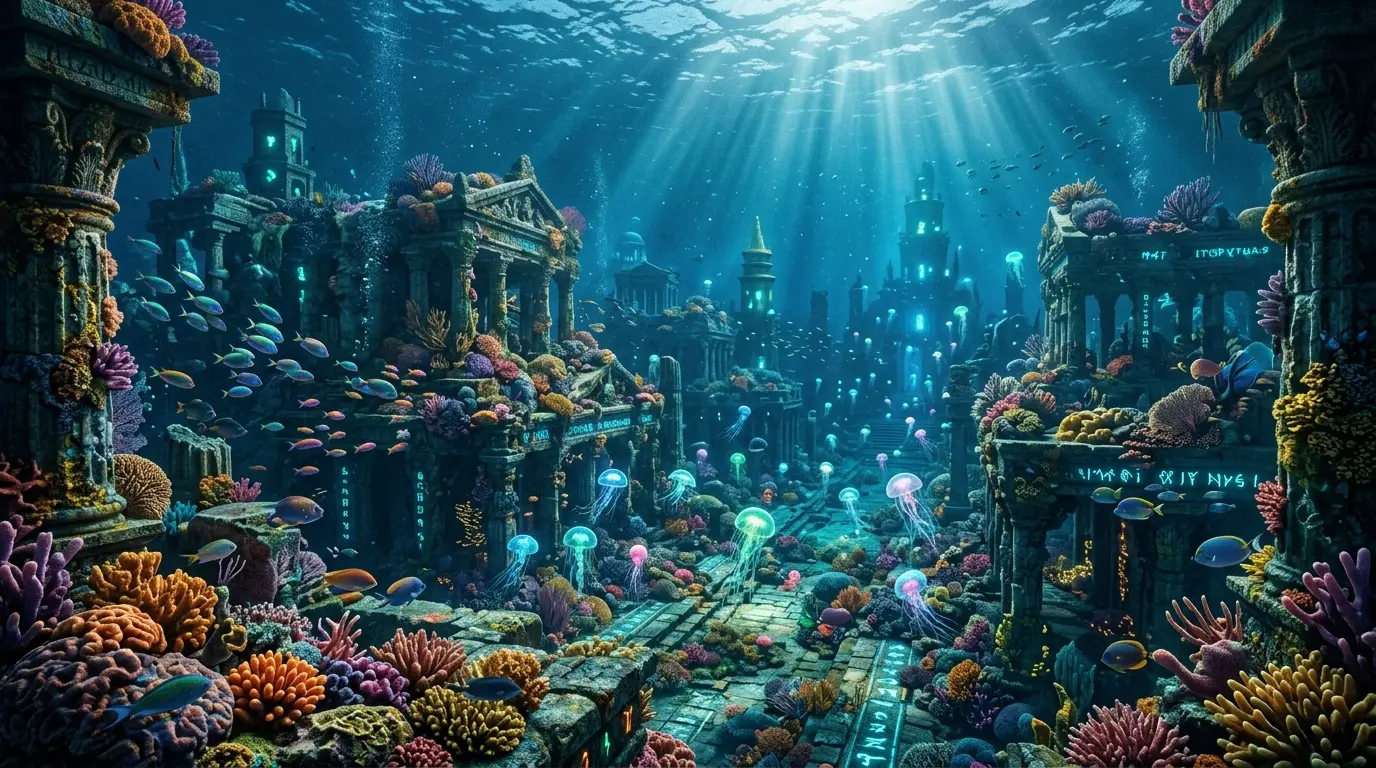
Using a 14mm wide-angle lens forces the AI to capture the grand scale and extreme depth of the cityscape. We added "realistic water scattering" to ground the fantasy concept in authentic underwater photography.
A hyper-detailed, photorealistic wide-angle shot of a mystical underwater city. Ancient, ruined stone architecture intricately covered in lifelike, colorful coral reefs. Glowing bioluminescent jellyfish and iridescent fish swimming through the streets. Authentic volumetric ray tracing filtering down from the ocean surface, illuminating the murky blue water. Captured with a 14mm wide-angle lens, cinematic lighting, realistic water scattering and marine snow, 8k resolution, documentary photography --v 6.1 --style raw --ar 9:16
2. The Macro Texture Shot (Flora & Fauna Focus)
Specifying a 100mm macro lens and a shallow depth of field (f/2.8) instructs the AI to blur the background and focus intensely on micro-details. Words like "translucent" and "fleshy polyps" force the model to render high-fidelity, lifelike textures.
A photorealistic macro photography shot of vibrant, glowing bioluminescent coral and an iridescent fish swimming past ancient, weathered stone. Extreme close-up, lifelike textures showing the pores of the stone and the translucent, fleshy polyps of the coral. Soft neon blue and green light emitting from the flora, shallow depth of field, captured with a 100mm macro lens at f/2.8, hyper-detailed, sharp focus on the fish's scales --v 6.1 --style raw --ar 9:16
3. The Architectural Low-Angle (Temple Entrance)
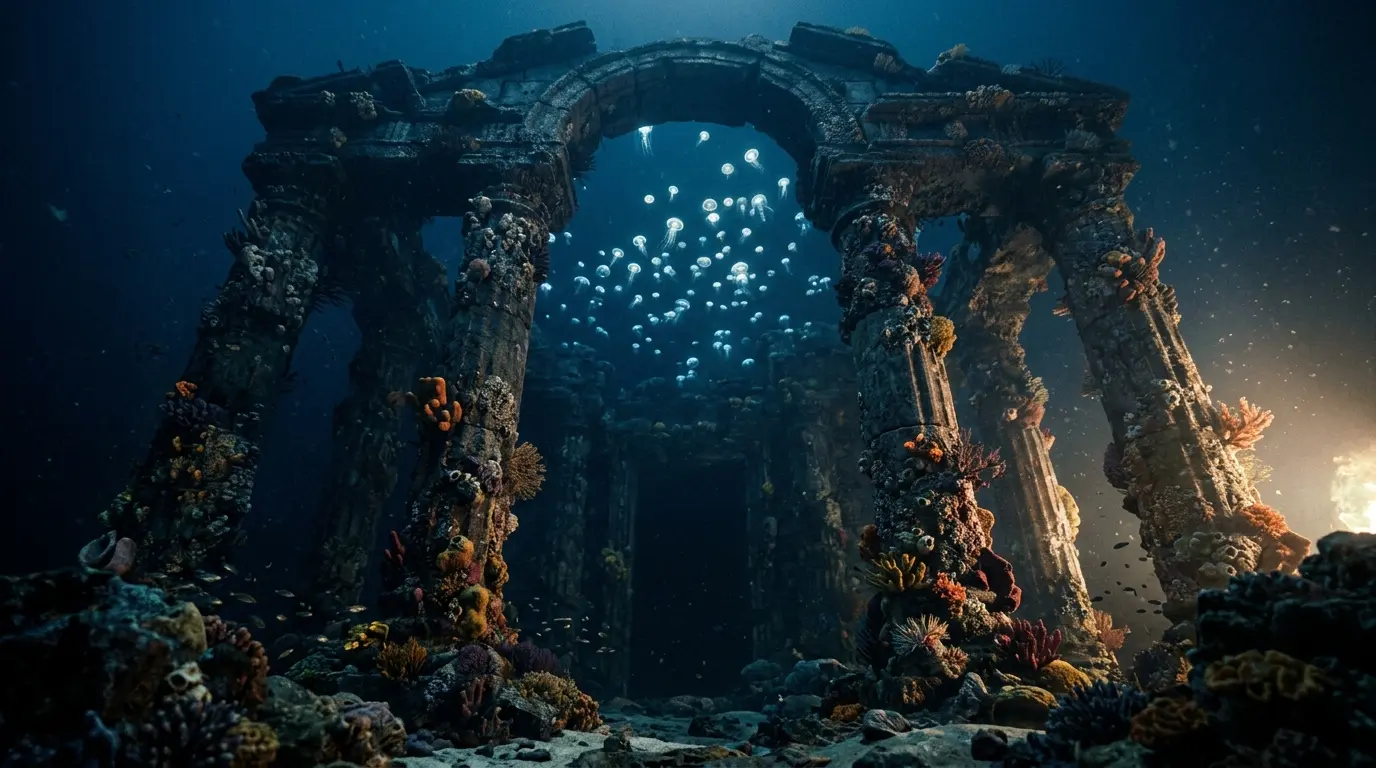
A low-angle perspective creates dominance for the architecture. The 35mm lens offers a natural field of view, while the Rembrandt 45-degree key lighting creates dramatic, high-contrast shadows across the textured stone, emphasizing its 3D form.
An ultra-realistic, low-angle photograph looking up at a towering, ruined underwater temple entrance. The ancient architecture is heavily encrusted with photorealistic barnacles and colorful coral. A swarm of glowing jellyfish floats gracefully above the pillars. Rembrandt window sidelight 45 deg key from a glowing underwater anomaly, deep shadows, captured with a 35mm lens, cinematic color grading, lifelike underwater density --v 6.1 --style raw --ar 9:16
4. The Creature Interaction (Statue & Fish)
By referencing National Geographic wildlife photography, we instruct the AI to adopt a highly professional, documentary aesthetic. The 50mm lens mimics the human eye, making the viewer feel like a diver directly encountering this magical scene.
A breathtaking, photorealistic image of a school of highly detailed, iridescent fish swimming around the face of a sunken, ancient stone statue. The stone is weathered with realistic algae and glowing moss. Bioluminescent light reflects authentically off the shiny scales of the fish. Shot with a 50mm lens, human-eye perspective, cinematic lighting, sharp focus, National Geographic wildlife photography style, 8k resolution --v 6.1 --style raw --ar 9:16
5. The Deep Trench View (High Angle)
A high-angle shot looking down emphasizes the vastness of the ruins. Coupling a high-end medium-format camera (Hasselblad X2D 100C) with a dark, moody atmosphere pushes the AI to prioritize sophisticated color handling and dynamic range.
A hyper-realistic, high-angle photograph looking down into a deep, glowing trench of a ruined underwater city. Streets lined with bioluminescent flora emitting soft pastel glows. Iridescent fish darting through the shadows. Dark, moody, high-pressure deep-sea atmosphere. Volumetric light beams cutting through the dark water. Captured with a Hasselblad X2D 100C, 80mm lens, professional underwater cinematography, cinematic depth --v 6.1 --style raw --ar 9:16
6. The Interior Sanctum (Caustic Lighting Focus)
Referencing architectural photography with a 24mm lens ensures perfectly straight framing of the indoor space. The most crucial technical prompt here is caustic light patterns, which perfectly simulates the dancing light refractions seen in shallow oceans.
A photorealistic interior shot of a ruined, flooded ancient hall. Intricate, highly detailed stone carvings covered in colorful marine life. Glowing jellyfish act as floating chandeliers, casting a warm, ethereal light. Highly realistic caustic light patterns dancing across the stone floor. Captured with a 24mm lens, professional architectural photography, sharp focus, hyper-detailed textures --v 6.1 --style raw --ar 9:16
7. The Depth of Field Focus (Foreground Jellyfish)
Using an 85mm portrait lens paired with a beautiful bokeh effect tells the AI to create an intimate focus on the foreground subject (the jellyfish) while blurring the background city into soft, glowing shapes. This perfectly mimics how a real camera behaves underwater.
An ultra-realistic, cinematic photograph focused on a highly detailed, glowing, translucent jellyfish in the immediate foreground. In the blurred, out-of-focus background, the magnificent ruins of an underwater city and colorful coral reefs. Beautiful bokeh effect from distant bioluminescent lights. Shot with an 85mm portrait lens, very shallow depth of field, hyper-realistic water dynamics, 8k --v 6.1 --style raw --ar 9:16
Final Prompt Engineering Lessons
Great prompts are never built by randomly throwing adjectives at a machine. As we have proven in this masterclass, truly breathtaking AI art is achieved by combining structural composition strategy, visual lighting psychology, and strict camera engineering into a single, cohesive creative direction.
If you learn to think like a Lead Photographer—choosing a 14mm lens when you want scale, and a 100mm macro lens when you want texture—your AI-generated assets will immediately transform from basic fantasy generations into agency-level commercial art.