Viral Cinematic AI Football Campaigns: The Ultimate Text-to-Video & Image Prompt Guide
Introduction: The Shift to Multimodal Sports Campaigns
Creating a generic image of a football player is simple. Engineering a multi-layered, cinematic sports advertisement featuring dynamic motion, 3D text overlays, and particle physics is a completely different discipline. Today's commercial sports brands (like Nike or Adidas) rely on extreme visual impact: rapid pacing, explosive kinetic energy, and dramatic color contrast.
With the recent explosion of Text-to-Video Generation (such as Runway Gen-3, Sora, and Kling) and advanced Multimodal Prompting techniques [1, 4], AI can now render these broadcast-quality commercials directly from text. However, to achieve this, you must stop writing simple descriptions. You must learn to engineer a Spatial Layout and a Visual Timeline.
In this 2000-word masterclass, we will deconstruct an incredibly advanced master prompt for a Brazil No. 10 Football Campaign. Because the source prompt explicitly asks for a "6-second duration," "audio design," and "camera push-ins," we will explore how this architecture applies perfectly to AI Video generation, and how we can adapt its intense visual psychology for high-end AI Image generators like Midjourney v6.1 and FLUX.
The 5 Pillars of Cinematic Multimodal Prompting
As documented in recent prompt engineering studies (such as those exploring structured outputs and format control in the Awesome-Prompt-Engineering lab [5]), providing the AI with a rigid, hierarchical structure drastically reduces hallucinations. To generate this explosive football campaign, the prompt is divided into five critical pillars.
1. Character Constraints & Anti-Hallucination
AI models notoriously struggle with sports uniforms, often mixing colors or mangling logos. To fix this, you must be hyper-literal. Do not just say "Brazil jersey." The master prompt commands: "wearing Brazil national team No.10 home jersey (yellow base with green trim), blue shorts, white football socks and blue football boots." Adding the phrase "Character deformation and incorrect clothing color matching are strictly prohibited" acts as a negative constraint, forcing the model to respect the color boundaries.
2. Spatial Literalism (Foreground, Midground, Background, Overlay)
If you don't define the Z-axis (depth), the AI will blend the text, the player, and the stadium into a messy collage. As taught in our previous tourism branding guides [6, 7], we must engineer the Composition Hierarchy.
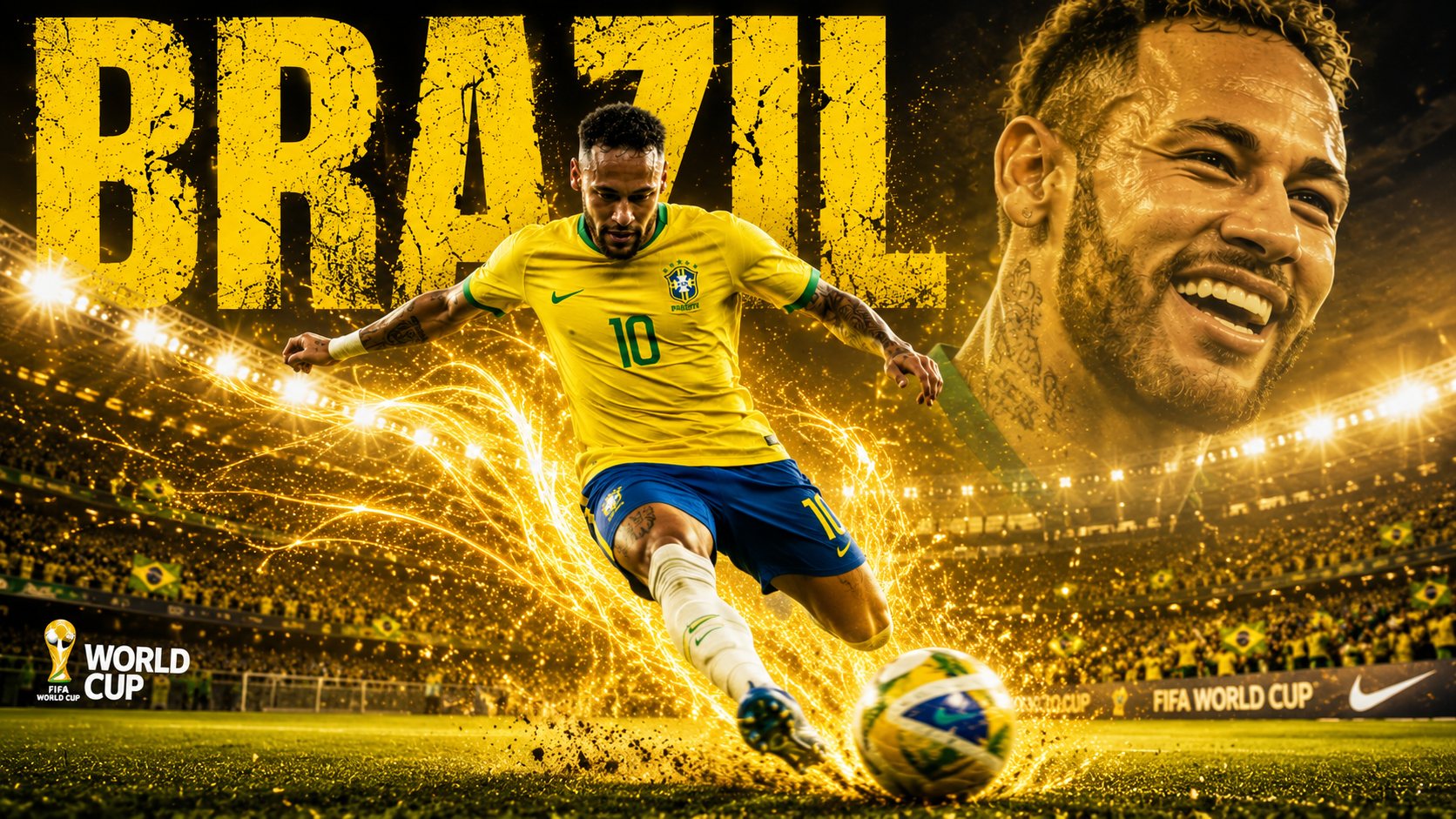
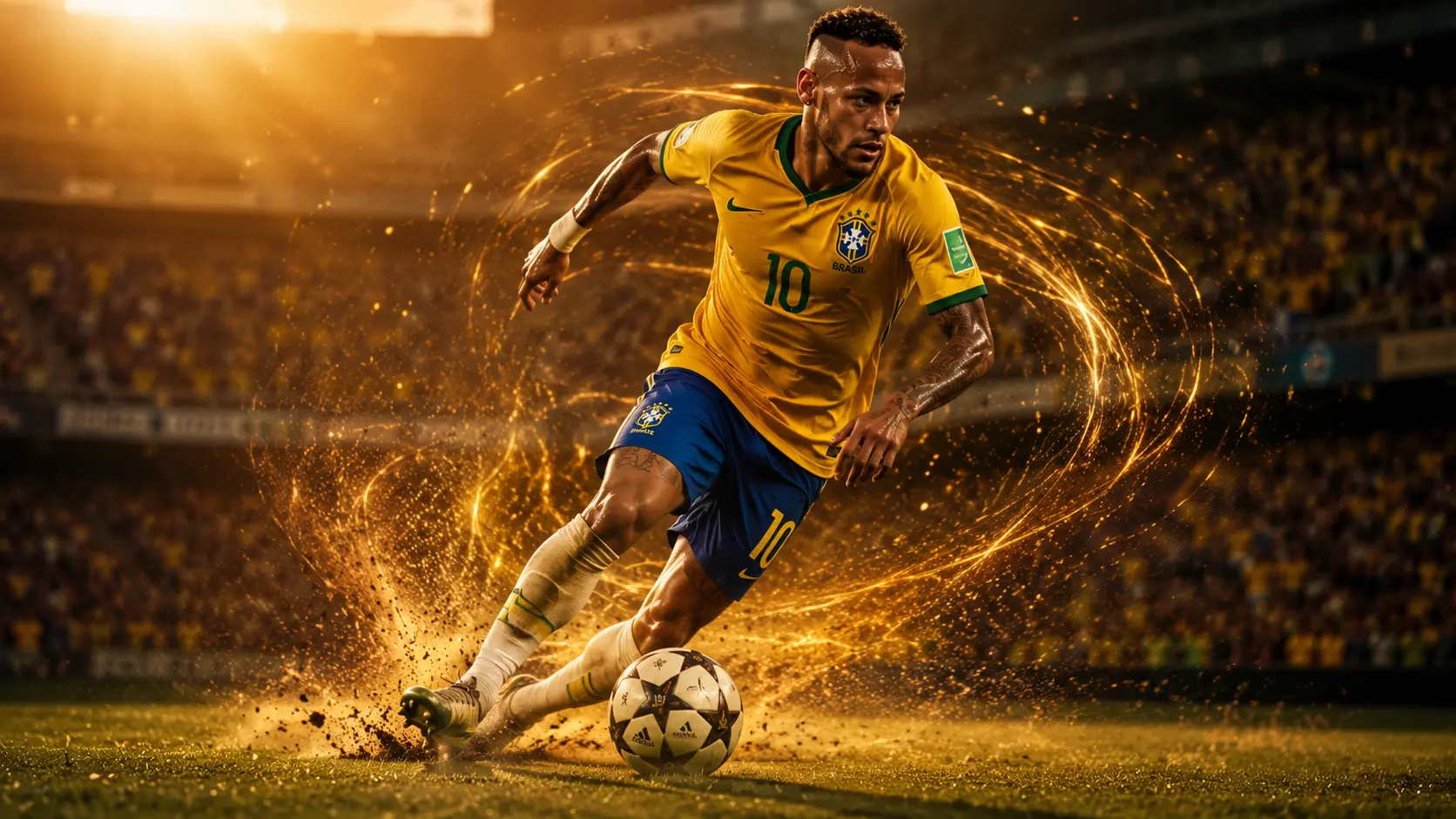
In this prompt, the layout is strictly defined: The Foreground is the sprinting player. The Midground contains the "fast-rising streams of golden light particles." The Background is the blurred stadium. Crucially, the Overlay places distressed typography and a blurred close-up in the upper third of the 9:16 vertical frame. This Spatial Literalism is exactly how graphic designers build Photoshop files.
3. Visual Psychology & Lighting Physics
To communicate explosive energy, we cannot use natural daylight. The prompt utilizes a "high-saturation warm gold palette paired with contrasting colors" and "sharp lighting effects resembling stage spotlights." This sculpts the player's muscles and creates dramatic tension, separating him from the dark stadium background. The addition of "dynamic motion blur" mimics the physics of a fast-moving physical camera.
4. Cinematography Strategy (For Video AI)
When prompting Text-to-Video models [1], you must act as the Director of Photography. The prompt specifies a "Low-angle slow push-in shot." By keeping the focus locked on the running figure while the camera moves closer, the background naturally gains "subtle additional blur" (parallax effect). This creates intense, cinematic drama that static images simply cannot replicate.
5. The Visual & Action Timeline (0-6 Seconds)
Standard image prompts fail in video generation because they don't account for time. You must map out the chronological action. The prompt breaks down the 6-second rhythm: The player strides, smiles, lifts his leg, strikes the ball, and the golden particles surge. This timeline acts as a script for the AI video generator's temporal engine.
Prompt Audit Scorecard: Deconstructing the Architecture
Why this specific structure guarantees a hyper-realistic, commercial-grade output:
| Category | Score | The AI Reasoning |
|---|---|---|
| Spatial Geometry | 10/10 | Explicitly defining the 4 layers (Foreground, Midground, Background, Overlay) prevents elements from bleeding into each other. |
| Temporal Logic (Video) | 10/10 | Providing a strict 0-6 second timeline gives video models like Runway Gen-3 exact instructions on pacing and kinetic energy. |
| Texture Fidelity | 9.5/10 | Micro-details like "jersey fabric, skin texture, and granular surface of the football" force the AI to render photorealistic materials. |
3 Master Prompts for the Brazil Football Campaign
Below are 3 meticulously engineered master prompts adapted from the original DNA. Because the original request spanned both video elements (timelines, audio) and image elements (posters, overlays), I have provided specific prompts optimized for Text-to-Video models (like Kling or Runway) and Text-to-Image models (like Midjourney v6.1 and FLUX).
1. The Full Cinematic Text-to-Video Prompt (Runway Gen-3 / Kling)
Logic Breakdown: Video models require a focus on camera movement and temporal action. We use the exact 0-6 second pacing and "Low-angle slow push-in shot" to ensure the AI understands the kinetic energy required. We also retain the 9:16 aspect ratio instruction for TikTok/Reels optimization.
A cinematic 9:16 vertical live-action short video (6 seconds). Character: A realistic football player wearing the Brazil national team No.10 home jersey (yellow base with green trim), blue shorts, white socks, and blue boots. He has an energetic, excited expression. Visual Style: High-saturation warm gold palette, sharp stage spotlights, hyper-realistic textures on the jersey and skin. Action Timeline: The camera executes a low-angle slow push-in shot. The player strides forward smoothly, lifts his leg, and kicks the football with explosive force. Midground: Bright, dense golden light particles surge rapidly behind him. Background: A brightly lit World Cup stadium filled with cheering spectators, processed with a shallow depth of field. Overlay: In the top third of the frame, a large bold distressed typography reading "BRAZIL" remains static and clearly visible above the action. Fast progressive pacing, dynamic motion blur, extreme visual impact.
2. The Midjourney v6.1 / FLUX Poster Image Prompt (Freeze-Frame)
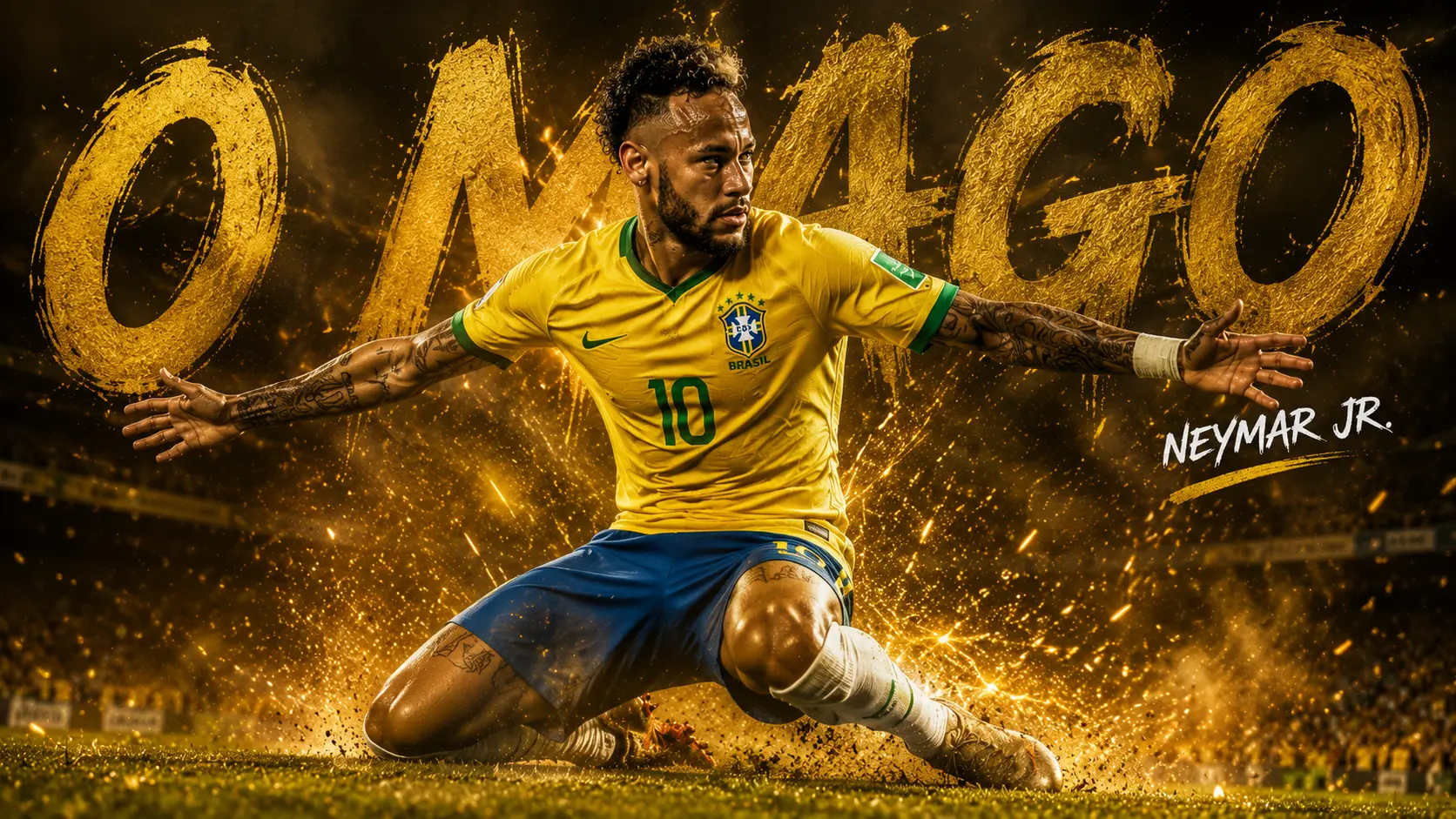
Logic Breakdown: Image generators cannot process a 6-second timeline or audio design. Instead, we must capture the exact peak moment of action (the "freeze-frame"). We heavily emphasize Typography Engineering here to ensure the distressed "BRAZIL" text renders flawlessly [8, 9], while using the "double exposure overlay" concept for the floating face in the sky.
A hyper-realistic, cinematic 9:16 vertical sports campaign poster. Foreground: A dynamic football player wearing a Brazil national team No.10 home jersey (yellow base, green trim), blue shorts, white socks, and blue boots. He is captured mid-stride, kicking a highly textured football with explosive kinetic energy. Midground: Fast-rising streams of glowing golden light particles surging behind him. Background: A blurred World Cup stadium with cheering spectators under sharp stage spotlights. Overlay Typography: Spanning the upper frame is large, bold uppercase text reading "BRAZIL" featuring a heavy street-style distressed texture. Next to the text is a heavily blurred, transparent close-up of the player's smiling face seamlessly blended into the stadium lights. High-saturation warm gold palette, extreme visual impact, commercial Nike aesthetic, 8k resolution --ar 9:16 --style raw --v 6.1
3. The High-Fashion Sports Editorial (Studio Lighting)
Logic Breakdown: If you want to pivot the campaign from an explosive stadium video to a high-end luxury editorial, you must remove the chaotic background and introduce studio lighting physics. We use a "clean dark backdrop" and "Rembrandt key lighting" (borrowed from our luxury photography frameworks) to sculpt the athlete's physique and highlight the fabric textures.
A hyper-realistic, high-fashion sports editorial photograph. Character: A powerful football player wearing a pristine Brazil No.10 home jersey (yellow base, green trim). He is posing confidently, holding a highly textured football against his hip. Lighting: Shot in a professional studio against a pitch-black background. Illuminated by a sharp, warm gold 45-degree Rembrandt key light and a subtle emerald green rim light, sculpting his muscles and the intricate fabric texture of the jersey. In the background, subtle, floating golden light particles drift slowly through the air. In the top left corner, distressed bold typography reads "BRAZIL". Shot on a medium format Hasselblad camera, 85mm lens, intense dramatic tension, 8k resolution --ar 4:5 --style raw --v 6.1
Agentic Workflows: Automating Your Sports Campaigns
If you want to generate this campaign for other national teams (like Argentina, France, or Japan), you shouldn't manually rewrite the prompt. Instead, rely on Agentic Workflows and Chain of Thought (CoT) reasoning [10, 11], a technique used by top prompt engineers researching frontier models like Gemini 3 Pro and GPT-5.2.
Feed your AI assistant this exact system instruction to automate your creative direction before generating the video/image:
"I am designing a viral, highly kinetic AI sports campaign. First, select a national football team. Second, define the exact uniform colors and trim to prevent AI hallucination. Third, establish a new thematic color palette (e.g., icy blue for Argentina, deep crimson for Spain) and a particle effect that matches. Finally, compile these elements into a highly structured, spatial prompt that dictates Foreground action, Midground particles, Background stadium blur, and Overlay Typography in a 9:16 aspect ratio."
Final Prompt Engineering Lessons
As we have proven with this Brazil No.10 campaign, truly breathtaking AI sports advertisements are achieved by combining strict spatial layering, intense visual psychology, and precise temporal scripts (for video). Whether you are generating a commercial product photograph or an explosive 6-second TikTok video, the rule of the Prompt Engineering University remains the same: Master the spatial layout, master the lighting physics, and you will master the AI.