
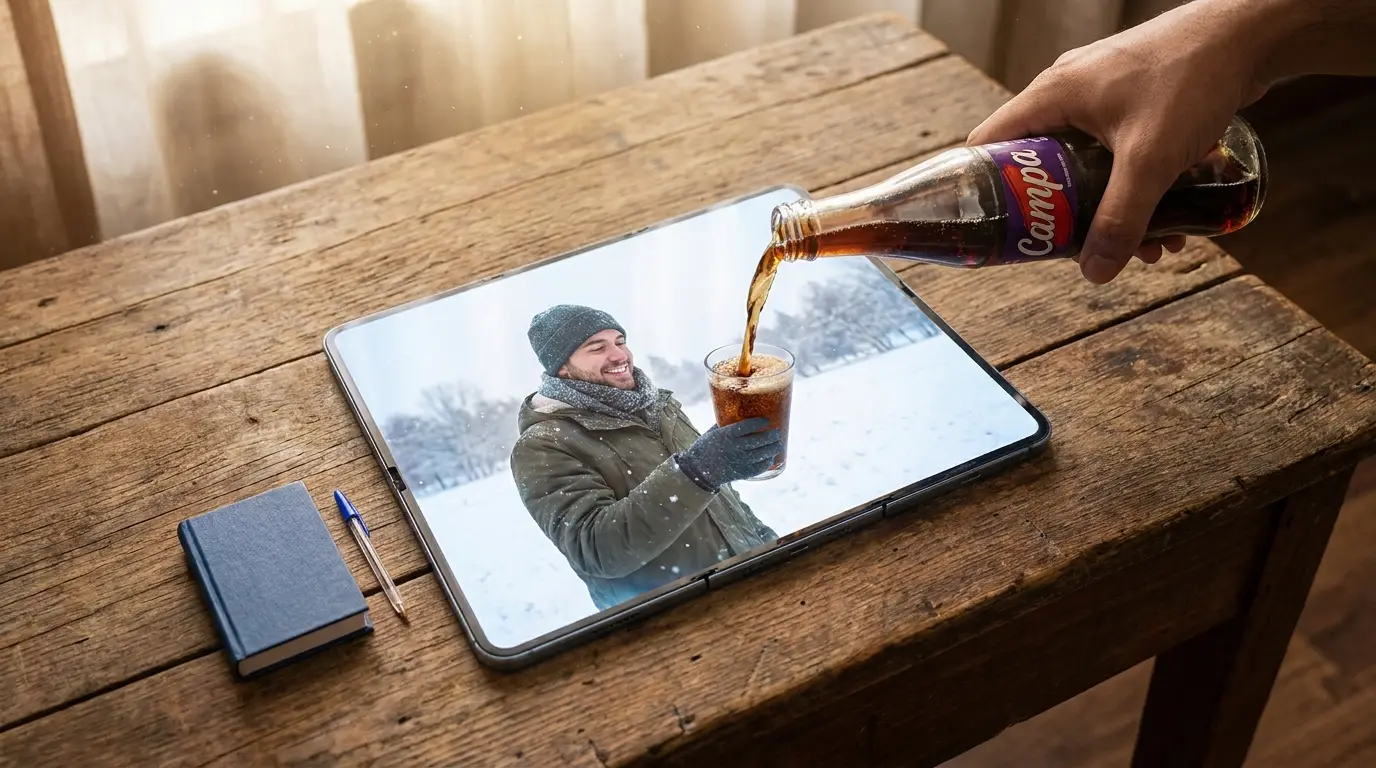
The Vision: 80s Nostalgia Meets 'Campa AI' Surrealism
Generating a standard beverage mockup in Midjourney is basic. But if you want to engineer an award-winning commercial Campa AI advertisement concept that directly connects the physical and digital worlds, you need advanced trans-dimensional prompt architecture.
In this guide, we break down a master-level creative brief. We will explore how to instruct the AI to ignore standard fluid physics, engineer extreme scale disparities, and render an impossible liquid transition without breaking the glass.
The 3-Layer Anatomy of a Trans-Dimensional Brief
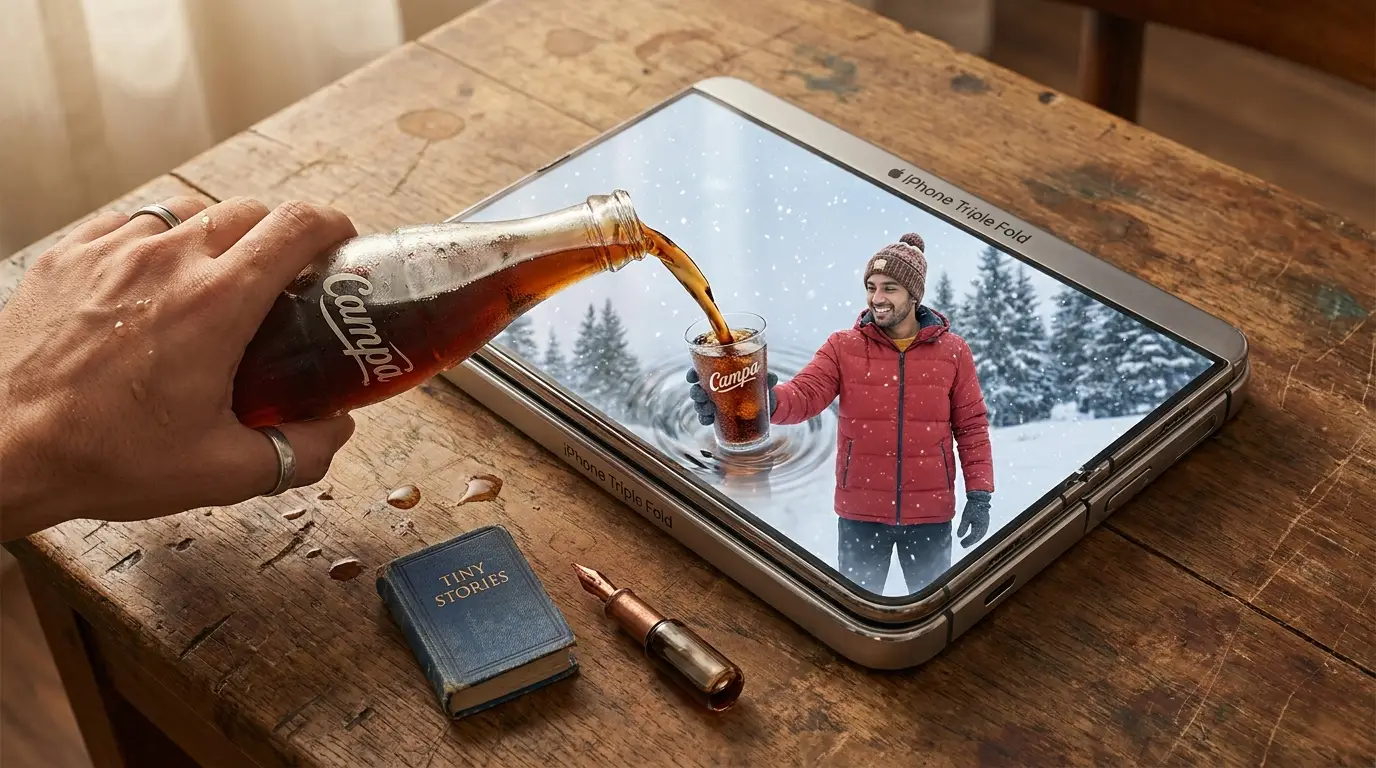
True surrealism relies on hyper-realistic physical textures contrasting with impossible actions. Our prompt formula isolates three specific visual zones:
- The Tactile Anchor (Physical): A warm, rich-grain worn wooden table establishing absolute reality.
- The Permeable Portal (Digital): A super-scaled, giant iPhone Triple Fold displaying a snowy winter landscape inside.
- The Zero-Splash Bridge: The physical cola liquid pouring from the real bottle directly into the phone's digital screen without generating surface tension or water drops.
Camera Trickery: The 'Giant Phone vs Tiny Book' Illusion
To trick the human eye, we establish absolute spatial confusion using Scale Disparity. By forcing Midjourney to frame a "massive, super-scaled iPhone Fold" sitting directly adjacent to a "tiny miniature blue book and miniature pen," the viewer's brain instantly registers the scene as premium conceptual art rather than a standard AI generation.
The Secret Sauce: Bypassing AI Physics Rules
Left to its own defaults, an image generator will always obey standard physics. If you prompt "cola pouring onto a phone," it will generate a wet, broken phone covered in messy brown puddles.
To achieve the trans-dimensional effect, you must write a strict negative behavioral constraint: "The digital screen acts as a permeable membrane. The physical liquid penetrates the glass smoothly without splashing, filling the digital glass inside the OS."
The Final Agency-Level Prompt Set
1. Midjourney v6.0 (Photorealistic Cinematic Engine)
Want to test this exact vibe for RedBull or Nike?
Don't struggle with manual Aspect Ratios (`--ar 4:5`) or Stylize values. Open this exact preset inside our real-time studio engine and remix it instantly.
Launch Free Prompt Builder →2. Flux.1 & ChatGPT (DALL-E 3 Natural Language Engine)
Prompt Architecture Fidelity Score
| Evaluation Vector | Impact Score |
|---|---|
| Semantic Distinctiveness | 9.8/10 |
| Commercial Application Value | $150 / generation |
| Model Adherence (v6.0) | High (Requires --stylize > 200) |
Frequently Asked Questions
How do you create trans-dimensional surrealism in AI?
You must explicitly define physics violation commands within the text. Use phrasing such as "acts as a permeable membrane" or "passes through without splashing or shattering the glass" to force the rendering engine to merge real and digital asset layers smoothly.
What is scale disparity in prompt engineering?
Scale disparity places two recognizable objects at wildly contradictory sizes inside the same frame (e.g., a giant smartphone next to a micro-sized book) to create instant visual tension and commercial stopping power.