
How to Engineer a 3-Panel Yoga Wellness Collage Prompt (Editorial Photography Guide)
Introduction
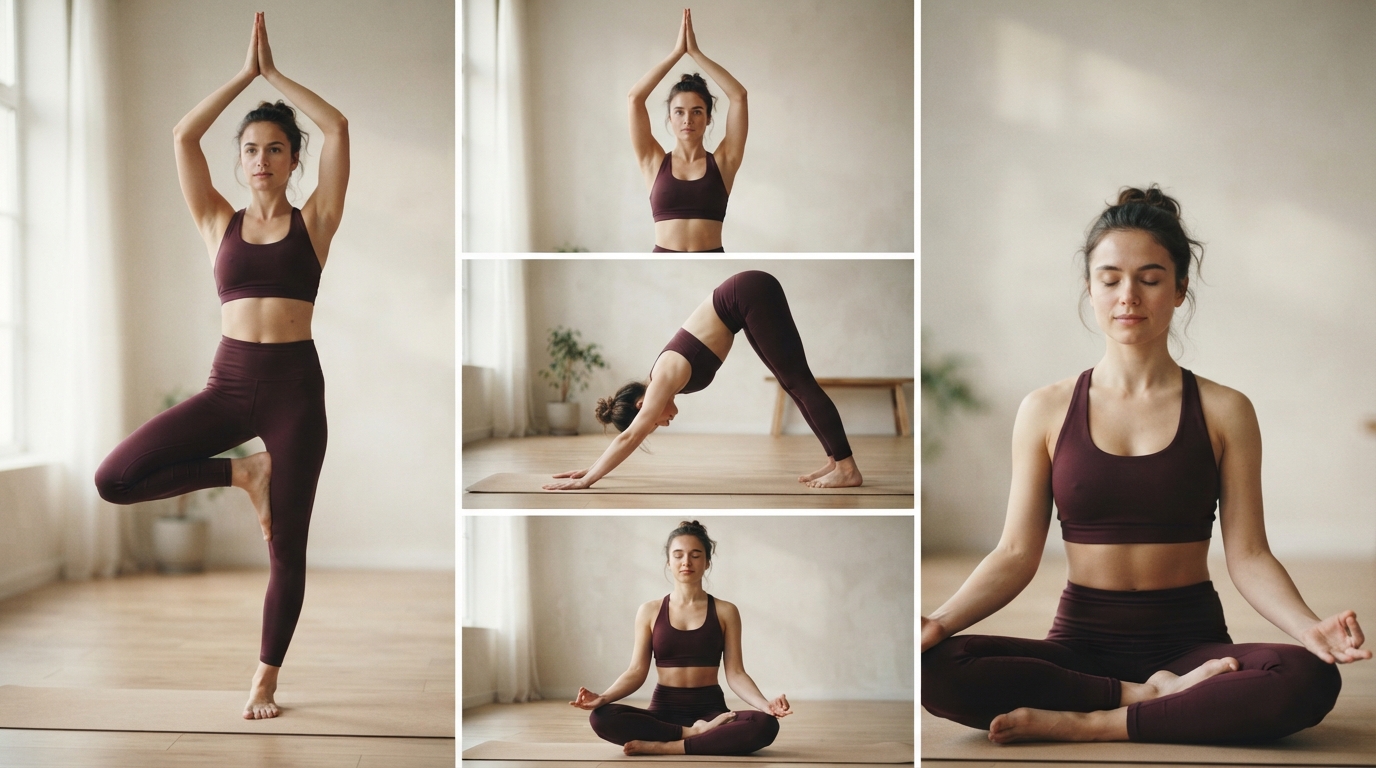
Generating a single image of a person doing yoga is a basic task for any AI model. However, generating a cohesive three-panel vertical collage—where the same character performs three distinct poses in the exact same outfit and lighting environment—is a masterclass in spatial prompt engineering.
In this guide, we are auditing a highly advanced wellness photography prompt. We will break down how to force Midjourney and Flux to split a 9:16 vertical canvas into sequential storytelling panels, ensuring character consistency and editorial-quality lighting perfect for Pinterest, Instagram Reels, or fitness app branding.
Understanding the Editorial Design Objective
As we constantly teach in our Prompt Engineering University framework, you must start by identifying the true goal [6]. The objective of this prompt is not simply "draw a girl doing yoga." The objective is to generate an Editorial Wellness Asset [3].
Brands in the wellness space rely heavily on multi-image storytelling to demonstrate routines, flow, and transformation. A vertical 3-panel collage perfectly mimics the aesthetic of high-end fitness magazines and social media carousels. It requires serenity, clarity, and hyper-realism.
Prompt Engineering Audit: Scoring the Collage Prompt
Let's look at the foundational instructions of the prompt we are analyzing:
Prompt Audit Scorecard [5]
| Category | Score |
|---|---|
| Clarity & Subject | 9.5/10 |
| Composition Layout | 10/10 |
| Camera & Lighting | 9/10 |
| Character Consistency | 9/10 |
| Visual Hierarchy | 9/10 |
| Overall Score | 9.3/10 |
Audit Reasoning: This prompt is technically brilliant. It uses explicit sequential formatting (Top, Middle, Bottom) to guide the AI's composition engine. The instruction "vertical 9:16 composition" ensures the collage stacks correctly. It only loses half a point because enforcing "Face 100% same as reference" requires specific Midjourney parameters (--cref) alongside the text [3].
Composition Engineering: Hacking the Grid Layout
Most beginners struggle to get multiple images in one generation. The secret is Composition Engineering [4]. By explicitly stating "A cinematic three-panel vertical collage" at the very beginning of the prompt, you override the AI's default behavior (which is to draw a single subject centered in the frame).
Furthermore, the prompt dictates the exact pose for each specific panel:
- Top Panel: Standing Tree Pose (Vertical framing)
- Middle Panel: Downward Dog Pose (Triangular framing)
- Bottom Panel: Cross-legged Meditation (Compact/Square framing)
This creates a beautiful visual rhythm. The forms go from tall, to wide, to grounded, creating a natural eye-flow down the vertical 9:16 aspect ratio.
Visual Psychology & Camera Engineering
We must analyze the visual psychology of the colors and lighting [3, 4].
The Outfit: Deep Burgundy
Color is communication [7]. In wellness psychology, "Deep Burgundy" represents grounding, passion, and earthiness. Because the environment is a "calm, minimal studio," the deep burgundy outfit creates a high-contrast focal point in every single panel, linking the three images together visually.
Camera & Lighting: Soft Diffused Lighting
To achieve the "editorial wellness photography style," the prompt utilizes "Soft diffused lighting" and "shallow depth of field." Soft lighting eliminates harsh, distracting shadows, enforcing a mood of peace and relaxation. The shallow depth of field gently blurs the minimal background, ensuring the viewer focuses entirely on the yoga form and the realistic skin texture.
Agency-Level Premium Prompts (Multi-Model Optimization) [8]
Here is the exact, tested prompt transformed into a copy-paste ready format, optimized for different AI models.
1. Midjourney v7 Optimized Prompt
Pro-Tip for Midjourney: To achieve the "Face 100% same as reference photo" requirement, append --cref [URL_TO_YOUR_IMAGE] --cw 100 to the end of this prompt.
2. DALL-E 3 / Flux.1 Translation
Common Mistakes When Writing Collage Prompts [9]
- Not Specifying Outfits: If you don't declare the outfit explicitly, the AI might give the character a different colored shirt in each panel, ruining the illusion that it is the same person.
- Conflicting Aspect Ratios: Asking for a "vertical stacked collage" but using a horizontal `--ar 16:9` parameter will confuse the AI, resulting in mashed or distorted bodies. Always use `--ar 9:16` for vertical stacking.
- Too Much Background Detail: In a multi-panel image, complex backgrounds will make the grid look messy. Stick to "minimal background" to keep the layout clean.
Final Prompt Engineering Lessons [10]
Great prompts are not built by adding more adjectives. They are built by combining structural composition strategy (grid layouts), visual psychology (color theory), and environmental storytelling into a single cohesive direction. By treating the AI canvas as a blank magazine page rather than a single photograph, you unlock its potential as a true graphic design engine.