
How to Engineer a Cinematic Fashion Portrait Prompt (Editorial Photography Guide)
Introduction
Generating a standard portrait with AI is incredibly easy. Generating a high-end, editorial fashion portrait that tells a story and grounds the character in a realistic environment is much harder. The difference lies in moving from simply describing a person to acting as the Art Director and Lead Photographer of a commercial campaign [3, 7].
In this guide, we are going to audit a fashion portrait prompt, break down its core elements, and upgrade it using professional camera engineering and visual psychology to create a stunning, agency-level commercial asset.
Prompt Engineering Audit: Scoring the Base Prompt
Before improving any prompt, a professional prompt engineer performs a strict audit [8]. Here is the base prompt we are analyzing today:
Prompt Audit Scorecard
| Category | Score |
|---|---|
| Subject Clarity | 9/10 |
| Lighting Instructions | 7/10 |
| Camera Engineering | 2/10 |
| Visual Psychology | 8/10 |
| Negative Prompting | 0/10 |
| Overall Score | 6.5/10 |
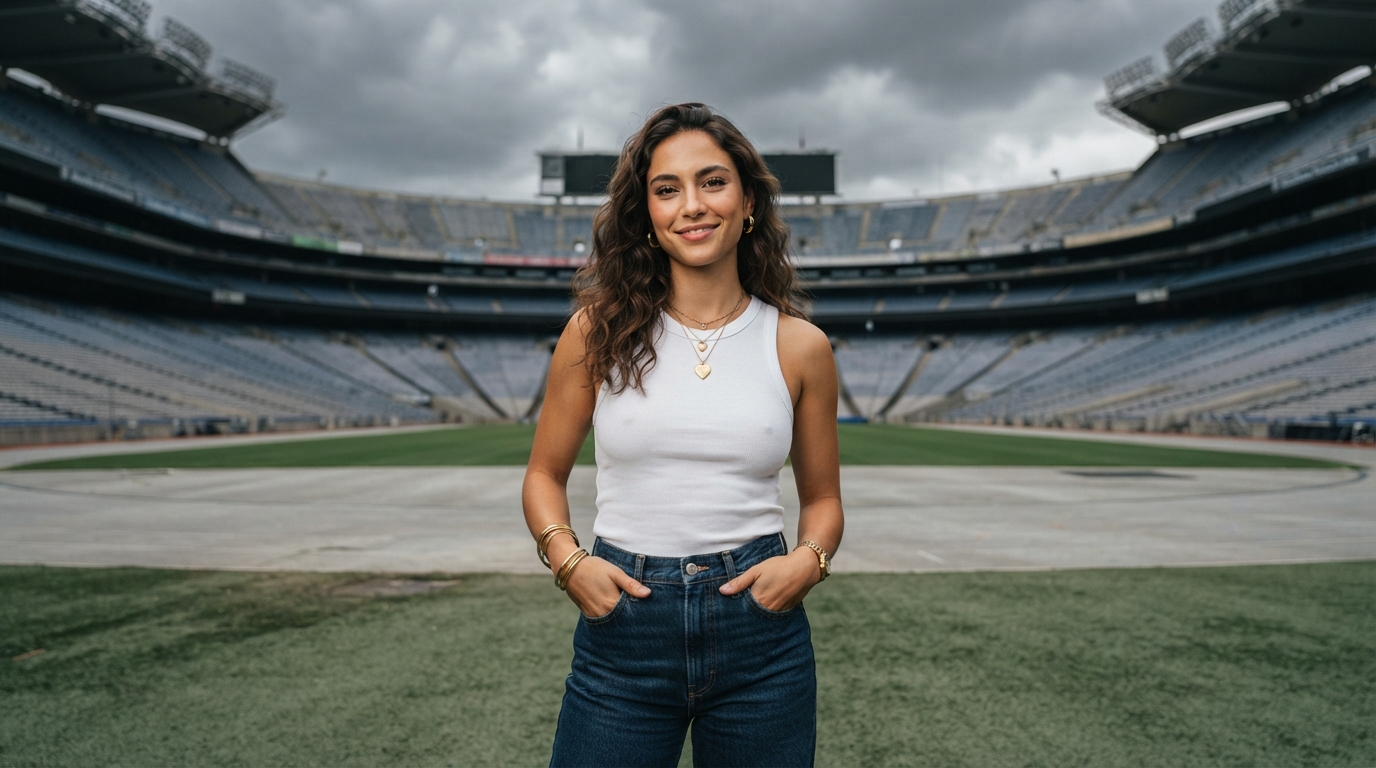
Audit Reasoning: The prompt excels at character design and wardrobe description [8]. It clearly establishes an appealing subject. However, it severely lacks Camera Engineering and Negative Prompting. Without specifying a lens, the AI will likely default to extreme background blur (bokeh), completely erasing the "large empty sports stadium" from the image.
Understanding the Editorial Design Objective
Professional prompts always begin with the final marketing objective [7]. This is not just a picture of a girl; this is a High-Fashion Apparel or Jewelry Campaign. The audience analysis tells us that viewers of this image (fashion enthusiasts or jewelry buyers) need to see the crisp details of the gold jewelry contrasting against a clean, uncluttered background [9].
Visual Psychology & Lighting Analysis
The original prompt includes a brilliant choice: "Dramatic overcast skies." Color is communication, and lighting dictates mood [10].
- The Softbox Effect: In professional photography, direct sunlight causes harsh, ugly shadows on a subject's face. Overcast skies act like a massive natural softbox, providing even, flattering light.
- Color Contrast: The muted, cool tones of the concrete stadium and grey skies provide a stunning visual contrast against the warmth of the subject's olive skin and layered gold jewelry. This visual psychology immediately draws the viewer's eye to the product being modeled [4].
- Scale Disparity: Placing a single, confident subject inside a massive, empty stadium creates a psychological sense of power, isolation, and cinematic scale.
Camera & Composition Engineering
Most prompt writers never think about lenses, but professional visual designers always do [11]. If you do not specify a lens, Midjourney will guess.
For high-end fashion portraits, we must engineer the camera instructions [12]. We will upgrade the prompt to include an 85mm portrait lens and an f/4 aperture.
- Why 85mm? It flatters facial proportions without the distortion caused by wide-angle lenses.
- Why f/4 aperture? We want to avoid the AI's "bokeh trap" (where the background is completely blurred out into a messy soup). An f/4 aperture ensures the subject is perfectly sharp while the stadium architecture in the background remains recognizable, preserving the environmental storytelling [13].
Negative Prompt Engineering
To ensure high output quality, professional prompts must also include negative instructions [5]. For portraits, we must tell the AI to avoid plastic skin textures, warped jewelry, over-saturation, and extreme background blur [5, 14].
Agency-Level Premium Prompts (Multi-Model Optimization)
Here are the exact, tested prompts transformed into an agency-level creative brief, optimized for different AI models [6].
1. Midjourney v7 Optimized Prompt
2. DALL-E 3 / Flux.1 Translation
Final Prompt Engineering Lessons
Great prompts are not built by adding more adjectives. They are built by combining branding objectives, visual psychology, composition strategy, camera engineering, and environmental storytelling into a single coherent creative direction [15]. By adding specific lens parameters and leveraging the overcast lighting as a technical softbox, your AI portraits will immediately look like multi-million dollar commercial photoshoots [3].