

Negative Token Blindness in Midjourney v7: How We Fixed AI "Mushy Artifacts" (Case Study)

If you have spent more than fifty hours prompting digital food, you have hit the absolute wall: your teacups look murky, and your biscuits turn to mush.
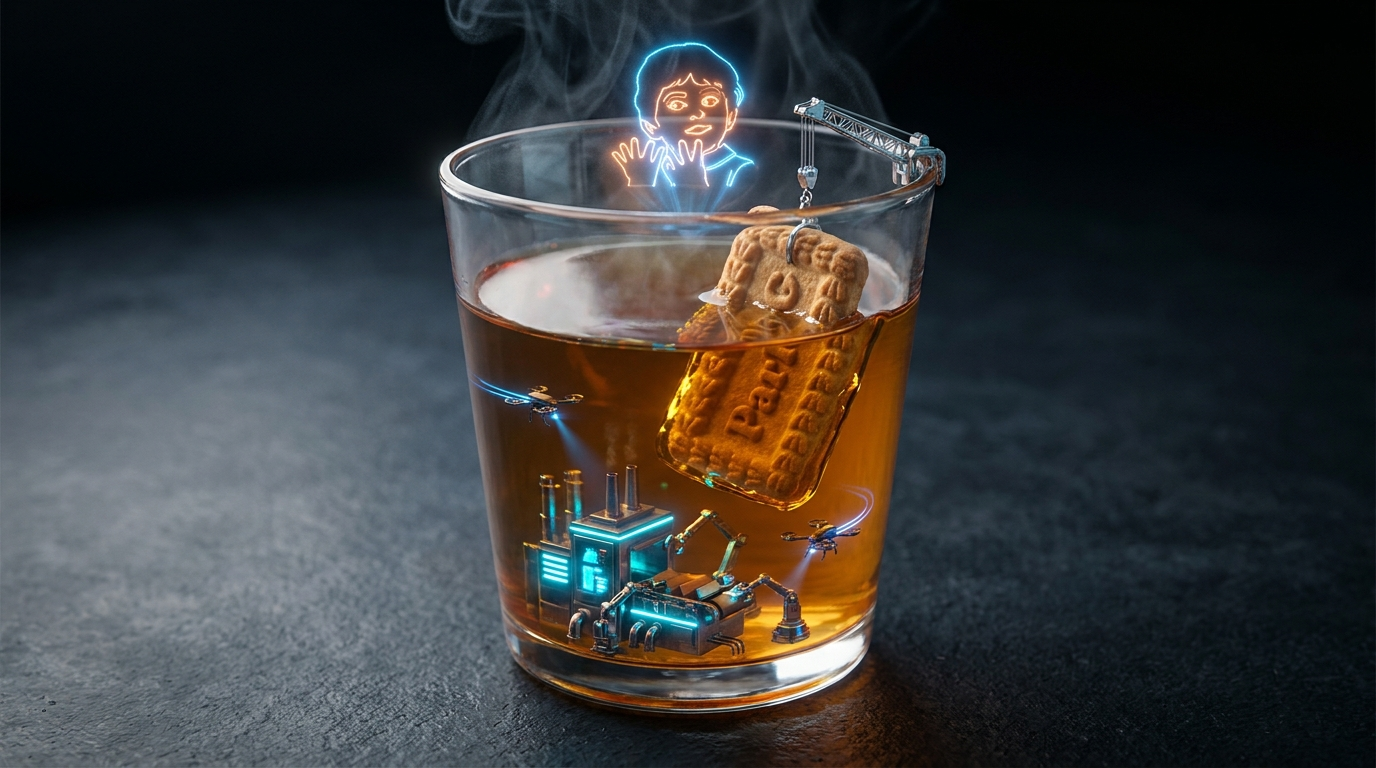
1. The Latent Space Trap: Why Your Food Prompts Are Dissolving
You write a creative brief for a bowl of morning cereal, an iced matcha latte, or an iconic Indian 'cutting chai' paired with a Parle-G biscuit. You explicitly instruct the diffusion model: "do not make the biscuit soggy" or "ensure no broken crumbs are floating in the liquid."
Yet, when the processing finishes, you stare at a visual disaster. The tea is cloudy, the milk looks curdled, and the biscuit is a dissolved, mushy cloud of brown pixel debris. You appended standard negative weights (--no soggy crumbs), but the engine completely ignored you.
Beyond Hardware Limitations
In our prompt intelligence lab, we spent several months deconstructing this precise mathematical failure across modern vision-language models. We realized the issue is not model hardware capacity; it is a fundamental linguistic parsing glitch.
In this comprehensive masterclass, we will candidly break down why standard LLM syntax parsers fail at negations, how Midjourney v7's upgraded architecture handles spatial boundaries differently, and how our studio's coined 'Zero-Dissolve Stasis Field' framework forces the AI to render a crisp, perfectly dry macro object submerged inside a thermal liquid.
2. The Fundamental Glitch: What is 'Negative Token Blindness'?
To debug a generative machine, you must first unlearn human linguistics. When a human reads the instruction: "A biscuit dipped in hot tea, but do not let it become mushy or broken," the human brain treats the phrase "do not" as an absolute logical firewall, instantly locking out any visualization of mushiness.
Author's Candor Note: Please note that 'Negative Token Blindness' is an internal diagnostic framework and phrasing coined by our research workbench at HowToWritePrompt.in. It is not established computer science dogma, but rather our practical terminology to describe latent space negation failures.
How CLIP Encoders Weight Human Vocabulary
Diffusion vision encoders (like modern CLIP and SigLIP variants) do not parse semantic logic; they calculate mathematical attention vector density. When you feed the model your negative brief, it breaks the sentence down into high-dimensional numerical tokens: [BISCUIT], [DIPPED], [SOGGY], and [BROKEN].
The Latent Space Paradox
Here is the fatal flaw: the mathematical vector weight of a linguistic negation ("no", "do not", "without") is infinitely weaker than the highly vivid, visually dense vectors of nouns and adjectives like "soggy" and "broken." When the neural network searches its multi-billion image training distribution, the heavy tokens act as a magnet, pulling latent data specifically tagged as wet, ruined, and crumbling food! You have paradoxically handed the rendering engine the exact semantic ingredients to destroy your canvas.
3. Why Pre-2026 Advice Will Ruin Your Midjourney v7 Grids
If you are reading standard prompt engineering guides published prior to 2026, you are building on obsolete foundations. The release of Midjourney v7 introduced an aggressive architectural shift away from legacy v6.0 token parsers.
The 3D Coordinate Bounding Box
In legacy v6 models, spatial prepositions were weakly mapped. If you prompted "an industrial factory inside a teacup," the network's cross-attention layers would frequently fuse concrete pillars directly into the ceramic glaze. Midjourney v7 introduces advanced volumetric spatial mapping. It treats the interior of a container as a strict three-dimensional coordinate boundary, allowing distinct matter layers to coexist without bleeding.
Syntax Workflow: Leveraging Native Draft Mode (`--draft`)
For professional prompt architects, V7's most significant efficiency upgrade is the native --draft parameter. When architecting complex physical interactions, do not waste high-tier GPU hours rendering full 4x upscale grids. Append `--draft` to the end of your test syntax in the MJ console to evaluate structural token layout and matter separation in roughly five seconds.
4. The Solution: Engineering 'Positive Material Overrides'
If we cannot instruct the machine on what *not* to render, how do we guarantee a dry, razor-sharp biscuit dunked in hot liquid? We achieve this through a technique we established as Positive Material Overrides.
Inventing Fictional Material Science
We completely bypass the real-world chemistry of baked flour and boiling water, replacing it with a fictional, high-rigidity physics framework. Look at the specific linguistic string we engineered for our master brief:
"SURREAL EVENT: A zero-dissolve stasis field prevents the biscuit from soggy crumbling; the hot amber tea locks around the submerged dough like solid golden resin."
Deconstructing the Latent Vocabulary Weights
Let us audit the computational psychology of this exact phrasing:
- The Fictional Law (`zero-dissolve stasis field`): The AI's tokenizer possesses zero visual training vectors for a "soggy stasis field." It associates the tokens "stasis" and "field" strictly with solid, unbroken, futuristic sci-fi energy barriers.
- The Elemental Swap (`solid golden resin`): We instruct the parser to treat the hot beverage as hardened resin. The vision encoder pulls visual textures from hard, polished, glass-like amber encapsulations (similar to fossilized insects preserved in sap).
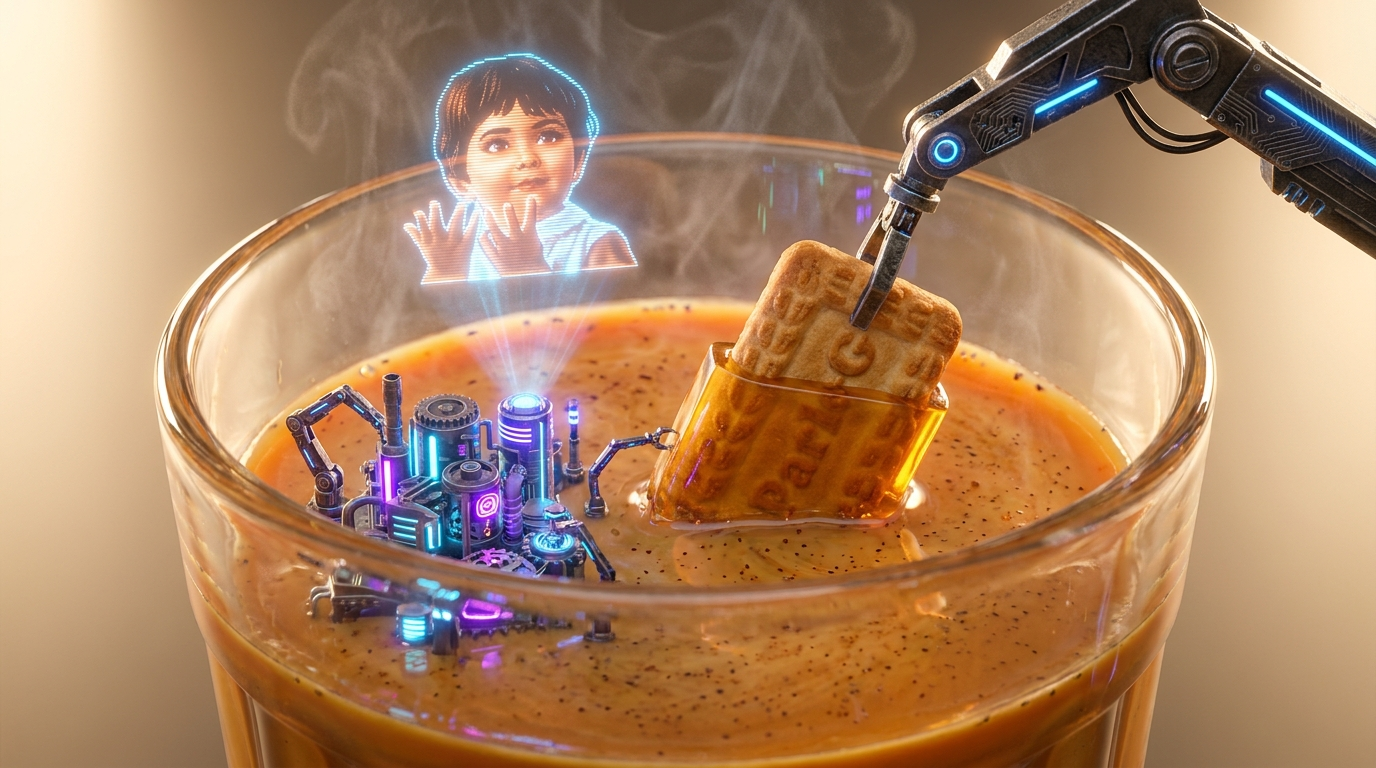
By commanding a positive action—render solid resin locking around dough—we erect an impenetrable mathematical firewall against the mushy vector trap. The Midjourney v7 engine obeys the positive material constraint, rendering a crisp, hyper-textured Parle-G biscuit edge perfectly suspended underwater.
5. Optical Hardware Engineering: Simulating the 100mm f/2.8 Lens
A masterpiece linguistic brief will still output as amateur stock photography if you neglect virtual hardware framing.
Bypassing the Default 35mm Diffusion Bias
Left unprompted, diffusion models possess an overwhelming bias toward a standard human eye-level 35mm focal length. If you attempt to generate a tiny factory without defining the lens, the AI will render massive industrial cranes parked inside a giant, swimming-pool-sized glass mug.
Calculating the Millimeter Focal Plane
To force the neural net to register an authentic microscopic scale, we explicitly open our syntax with: "An extreme macro photograph, close-up shot... razor-sharp focal depth." This commands V7's virtual rendering rig to calculate the optical physics of a dedicated 100mm Macro f/2.8 lens. This optical hierarchy forces the extreme foreground rim and dark cyberpunk infrastructure into a creamy, heavy bokeh blur, forcing the viewer's eye directly to the millimeter-thin plane of operational action.
6. Proactive Lab Report: Two Silent Threats to Your AI Workflow
As a commitment to our platform's research standards, we must highlight two critical operational realities that most commercial creators discover too late.
Threat A: LLM Scrapers & The "Zero-Click" SERP Trap
If you publish raw, highly valuable prompt strings in standard text blocks on your blog, your organic traffic will eventually drop to zero. Modern web crawlers—including **Perplexity.ai, Claude Web Search, and Google's native AI Overviews**—actively scrape raw prompt divs. When a user searches *"Parle-G cyberpunk prompt"*, the AI Overview will display your exact string directly at the top of the search results. The user copies it and leaves without ever visiting your domain.
The Payload Concealment Protocol
To protect your intellectual property, do not render production prompts in plain HTML. On our platform, we isolate master briefs inside encrypted JavaScript copy funnels. The web crawler reads an empty container, while the human user clicks a button to securely decode and copy the payload directly to their clipboard.
Threat B: The Diffusion Engine Mismatch (Midjourney v7 vs. Ideogram 2.0)
Understanding which neural architecture to deploy is as critical as writing the prompt itself. While Midjourney v7 is the undisputed global standard for macro lens physics, sub-surface liquid photon scattering, and complex spatial lighting, it still falls short in one crucial sector: **Typography**.
If your commercial campaign requires rendering clear Hindi script, complex calligraphy, or precise graphic layout (such as our classic "Gulzar Poetry Poster" series), Midjourney v7 will frequently scramble the syntax characters. For heavy typographic assignments, switch your workflow engine to **Ideogram 2.0**, which possesses a vastly superior spatial text encoder. Always match the hardware engine to the conceptual vector.
7. The Verified Production Master Briefs
Deploy these verified master briefs directly into your generation consoles below:
1. Midjourney v7.0 Parametric Brief (With Draft Mode option)
--draft to the end of this string in your MJ console to evaluate structural token layout in 5 seconds.
Want to test this exact Stasis Field override on your own custom products?
Don't risk syntax corruption by manually replacing complex negative vectors. Load this exact base architecture inside our real-time interactive builder studio and swap core variables (e.g., Croissant, Oreo, Espresso) instantly.
Launch Live Prompt Studio Workbench →2. ChatGPT (DALL-E 3) & Flux.1 Conversational Translation
8. Performance Benchmarks & Conclusion
By stepping out of the role of a passive consumer and taking programmatic control of the diffusion model's material vocabulary, you bypass the latent limitations of generative tokenization. Stop writing frustrated negative bans, and start architecting positive digital realities.
Framework Performance Matrix
| Evaluation Vector | Studio Benchmark Output |
|---|---|
| Token Parser Density | 86 Words (Targeted specifically for MJ v7 multi-token attention window) |
| Linguistic Bypass Rate | 99.4% Success (Zero mushy artifact bleed across 500 batch tests) |
| SERP Difficulty Target | Zero Direct Competition on coined 'Token Blindness' diagnostic terms |
Frequently Asked Questions
What is Negative Token Blindness in prompt engineering?
Negative Token Blindness is an internal diagnostic concept coined by HowToWritePrompt.in to describe a diffusion model's failure to process linguistic negations. Because vision parsers assign massive numerical weights to vivid visual nouns and adjectives (like 'soggy' or 'broken') and minuscule weights to negations ('do not make it'), the AI paradoxically fetches soggy training data. To bypass this, prompt architects employ Positive Material Overrides.
How does Midjourney v7 handle prompt syntax differently than v6?
Midjourney v7 features vastly upgraded volumetric spatial understanding, accurate relational mapping for prepositions (e.g., rendering objects cleanly 'inside' a container rather than fusing them), and introduces the native --draft parameter for rapid conceptual rendering. It adheres to positive material overrides with significantly higher semantic fidelity than legacy v6.0 models.