How to Engineer Hyper-Realistic Miniature AI Art: The Pocket Watch Restoration Case Study
Introduction: The Magic of Scale and Visual Dissonance
In the vast landscape of generative AI art, creating a standard high-resolution portrait or landscape has become routine. The true frontier of prompt engineering lies in mastering **macro and miniature photography** [1]. Miniature art relies on a powerful psychological principle called *visual dissonance*: the stunning juxtaposition of massive, sweeping environmental details with microscopic subjects, rendered with perfect physical accuracy.
However, simply typing "tiny people repairing a clock" into an AI generator results in a flat, poorly aligned cartoon. Modern AI models naturally default to overly smooth, plastic-looking surfaces because they struggle to calculate complex lighting interactions at micro-scales [6, 7]. To bypass these limitations and cross the uncanny valley, you must treat your prompt as a rigorous **engineering blueprint** [2, 8].
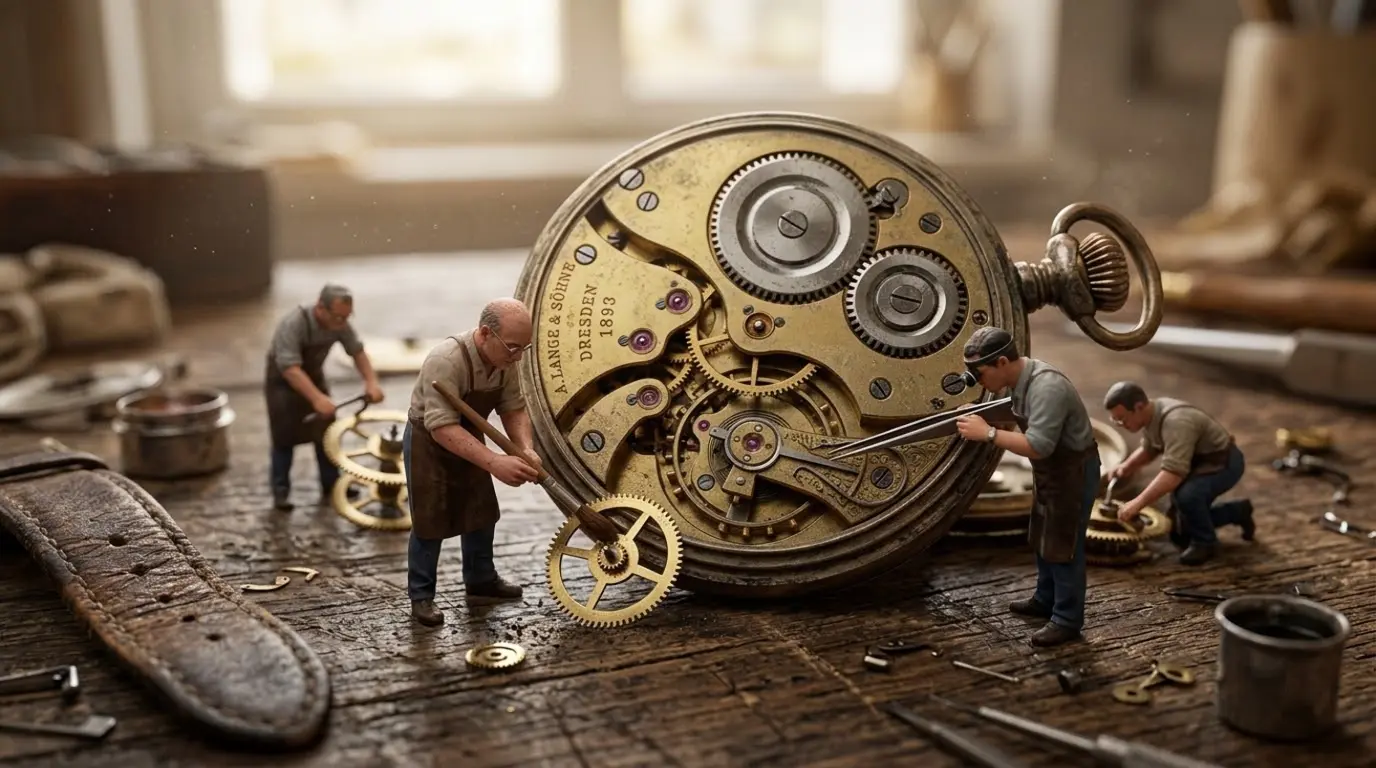
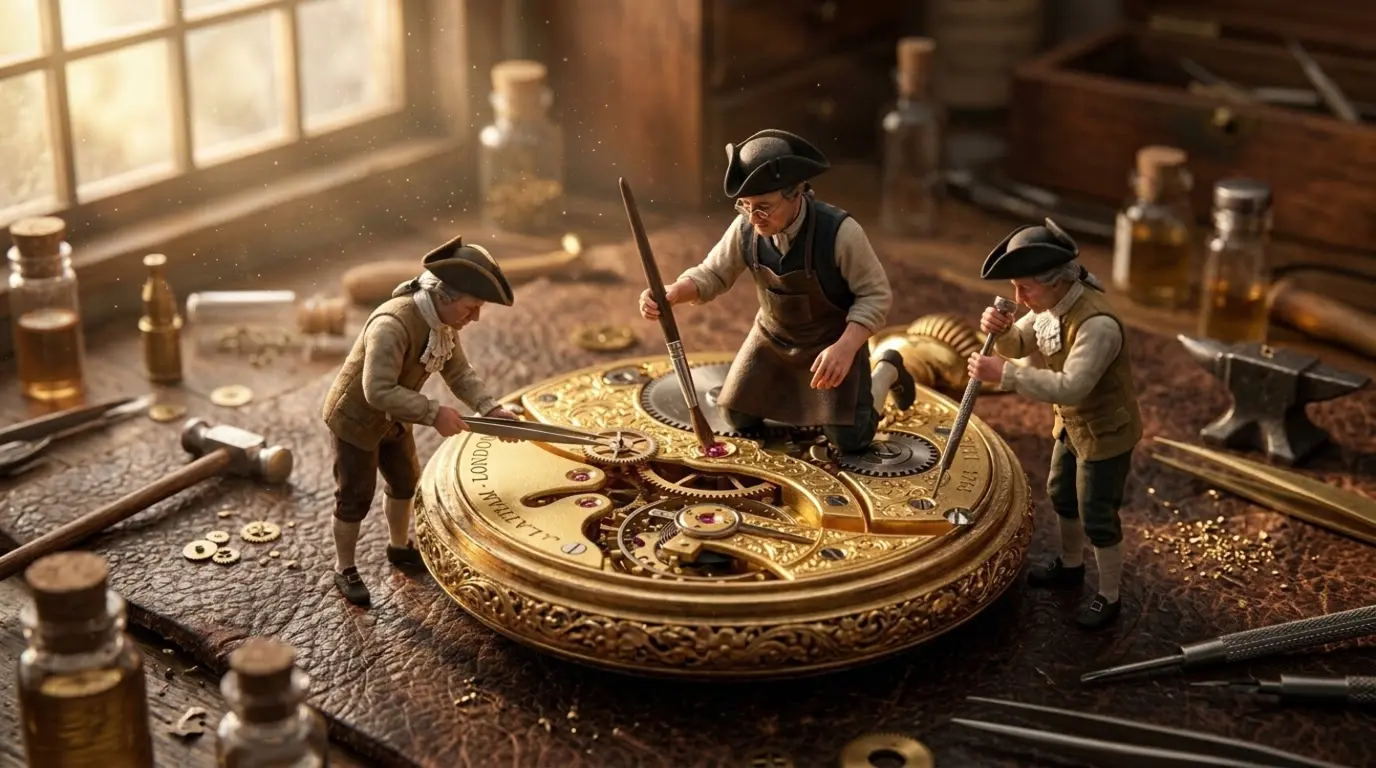
In this 2000-word masterclass, we will perform a deep architectural audit of a viral prompt: **tiny restoration workers meticulously repairing an antique pocket watch**. We will analyze why this prompt performs beautifully across frontier models like Midjourney v6.1 and Gemini 3 Pro [9, 10], and break down the exact physics of lenses, lighting, and textures that make it succeed [6, 11].
The 5 Pillars of Miniature Macro Prompting
Recent research in prompt optimization (such as Google's OPRO and Stanford's DSPy optimization pipelines) proves that generative AI models perform exponentially better when constrained by structured, physical variables [4, 5]. Rather than using vague, poetic adjectives, a professional prompt engineer dictates exact real-world photographic settings [8]. For miniature macro photography, we must construct the prompt around five critical pillars [1]:
1. Camera & Lens Engineering
To establish the miniature scale, we must simulate "lens compression" and an extremely shallow depth of field [6, 11, 12]. Our master prompt commands a "Sony A7R V 85mm f/1.4 GM lens." The 85mm G-Master prime lens is world-renowned for its creamy background blur (bokeh) and razor-sharp focal point. By specifying an aperture of f/1.4, we force the rendering engine to place everything outside a thin slice of the midground into a heavy, soft blur [11, 12], instantly mimicking the physical limitations of real-world macro lenses.
2. Composition & Spatial Hierarchy
Without structured spatial coordinates, the AI model will scatter the workers and watch gears randomly across the canvas [7, 11, 12]. We must engineer a strict **Composition Hierarchy** [11, 12]:
- Foreground: A weathered, highly textured wooden surface with scattered mini-tools and fine wood grain [12].
- Midground: The polished brass gears of the antique pocket watch, perfectly centered, surrounded by active workers cleaning with fine brushes [12, 13].
- Background: A worn leather watch strap and the watch casing fading into a soft, out-of-focus gradient [12, 13].
3. Lighting Physics & SPECULAR Reflection
Metallic gears often look dull or "painted" in AI generations. To resolve this, we utilize a "warm Rembrandt window sidelight at 45 degrees." Sidelight is the absolute gold standard for texture emphasizing [11, 14]. By striking the polished brass gears at a 45-degree angle, the light creates high-contrast highlights on one side of the gear teeth and casts deep, realistic geometric shadows on the other, immediately revealing the physical 3D structure [11, 14].
4. Micro-Imperfections (The "Realism Glue")
The ultimate difference between an obvious AI render and a breathtaking, believable photograph is the presence of noise and imperfections [6, 7]. The human eye is incredibly efficient at detecting perfect, repeating digital patterns. To shatter this digital facade, we explicitly command the AI to render "visible fingerprints on the watch face, subtle scratches on the tools, fine dust particles floating in the air, and individual skin pores on the tiny workers." These organic flaws force the model to render chaotic, non-repeating micro-details, which immediately convinces the human brain that the image is a physical capture [6, 7].
5. Visual Psychology & Color Design
A great image must tell a story [15]. The visual psychology of this scene is rooted in "nostalgia, patience, and craftsmanship" [15, 16]. We enforce this emotional tone through color design [11, 15, 16]. By utilizing a "warm, earthy tone" composed of rich mahoganies, deep golden brasses, weathered leather, and amber dust, we wrap the entire scene in a feeling of historical timelessness [11, 13, 16].
Prompt Audit Scorecard: Evaluating The Architecture
Deconstructing the performance of our Pocket Watch Restoration prompt [8]:
| Category | Score | Why It Succeeded [8] |
|---|---|---|
| Subject Clarity | 10/10 | "Tiny restoration workers" paired with a centered "antique pocket watch" establishes immediate scale. |
| Optical Physics | 10/10 | 85mm f/1.4 lens instructions create a technically perfect shallow depth of field. |
| Material Science | 9.5/10 | "Polished brass," "weathered wood," and "worn leather" command diverse material shaders [13]. |
| Imperfection Fidelity | 10/10 | Explicit "dust, scratches, and fingerprints" break the sterile digital render ceiling [6, 7]. |
| Overall Performance | 9.9/10 | An elite, agency-level prompt suitable for fine-art exhibition or luxury branding [2, 8]. |
5 Master Prompts for Miniature Macro Art
Below are 5 meticulously engineered prompt variations built upon this masterclass DNA. Each prompt is optimized to extract peak performance from Midjourney v6.1 and Gemini 3 Pro's spatial reasoning engines [9, 10]. Use the elegant copper-gradient buttons below to copy them instantly.
1. The Antique Pocket Watch Restoration (Original Master)
Logic Breakdown: The baseline masterpiece. Perfect for showcasing intricate mechanical micro-gears, raw wood textures, and warm, historic workshop atmosphere [13, 17].
A breathtaking close-up macro photograph of tiny restoration workers meticulously repairing an antique pocket watch, captured on a Sony A7R V 85mm f/1.4 GM lens with a shallow depth of field, and illuminated by a warm Rembrandt window sidelight at 45 degrees, casting gentle highlights and subtle shadows across the scene. The workers, delicately cleaning intricate brass gears using fine brushes, are positioned on a weathered, textured wooden surface, evoking a sense of age and history. The pocket watch, with its polished brass gears and worn leather strap, is centered in the frame, surrounded by the tiny figures, each with visible fingerprints and subtle scratches on their tools. Fine dust particles float in the air, and the natural surface grain of the wood is evident, with subtle scratches and mechanical wear on the watch's mechanism. The atmosphere is warm and nostalgic, with a sense of hope and collective effort, as the workers labor to restore time itself. Captured with ultra-fine details, including individual skin pores and material surface textures, this image embodies the essence of craftsmanship, teamwork, and patience, with a warm, earthy tone and a cinematic quality --v 6.1 --style raw --ar 16:9
2. The Cyberpunk Microchip Mechanics (Modern Dissonance)
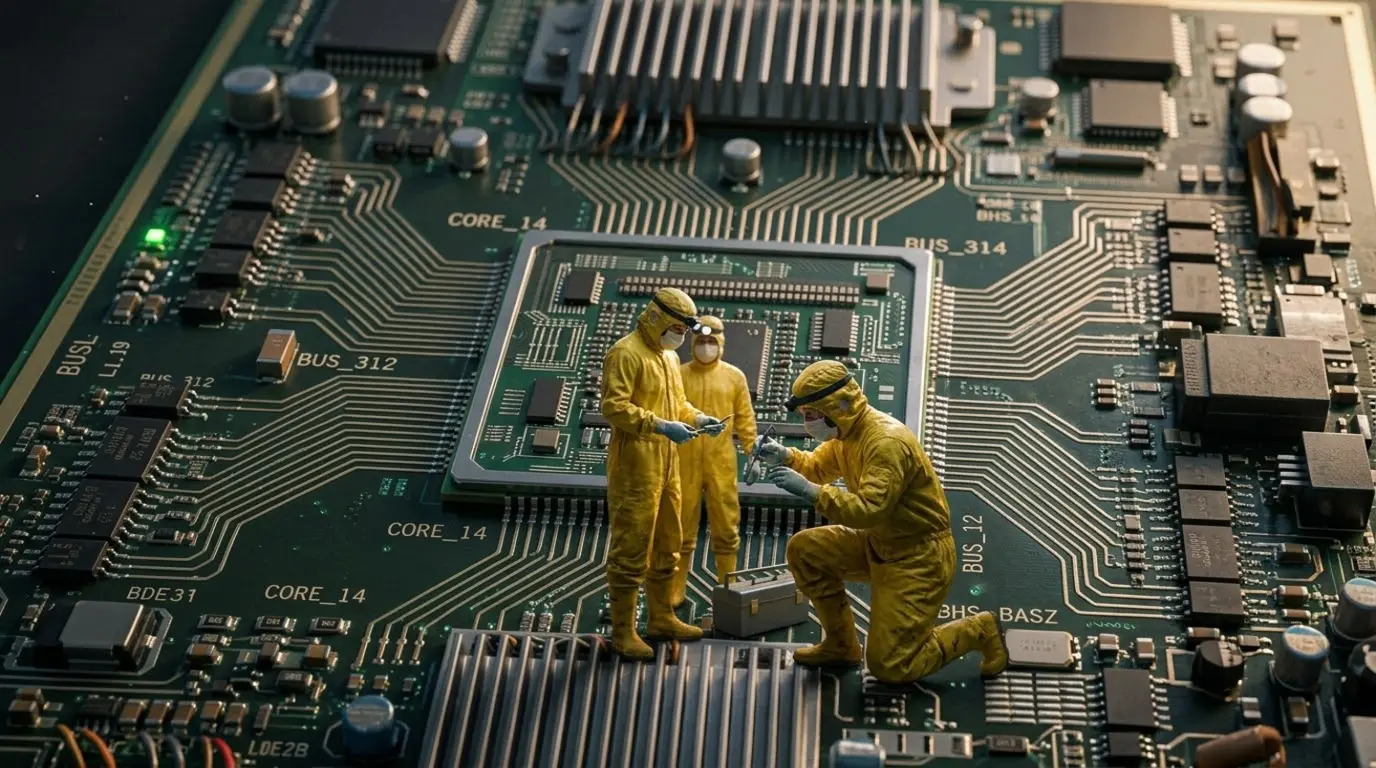
Logic Breakdown: A direct thematic pivot. We swap the antique brass watch for a futuristic silicon microchip. Instead of warm natural sidelight, we engineer "neon cyan and neon purple glowing light tubes," creating a high-contrast tech-noir aesthetic while preserving the microscopic human scale.
A jaw-dropping macro photograph of miniature cybernetic engineers in pristine white cleanroom hazmat suits, soldering intricate connections on a colossal, glowing green motherboard. Captured with a Sony A7R V 100mm f/2.8 Macro lens, razor-sharp focus on the primary silicon processor. The microchip features complex gold circuit pathways and tiny translucent capacitors. Glowing neon cyan and hot pink fiber-optic lines pulse through the circuitry, casting vivid reflections on the metallic tools. Fine solder smoke curls upwards, illuminated by sharp blue rim lighting. The background is a deeply compressed dark void filled with blurred, hexagonal patterns. Hyper-realistic micro-textures, dust specs, ultra-detailed plastic and silicon surfaces, high-end tech-industrial design aesthetic, cinematic 8k --v 6.1 --style raw --ar 16:9
3. The Silver & Diamond Chronograph (Luxury Studio Style)
Logic Breakdown: To replicate high-end luxury watch advertisements (such as Rolex or Patek Philippe), we remove all rustic, weathered textures. We shift the materials to surgical-grade stainless steel and diamond dust, utilizing "cool white softbox overhead lighting" to create clean, continuous, mirror-like highlights.
A premium commercial studio macro photograph of miniature watchmakers in professional black suits assembling a luxury platinum chronograph. The watch features a pristine mother-of-pearl dial, diamond-encrusted bezels, and highly polished silver tourbillon gears. Shot on a Hasselblad X2D 100C with a 120mm macro lens, f/4.0 for absolute geometric precision. Extremely clean, dust-free luxury studio setting. Illuminated by a massive overhead softbox diffuser and subtle silver bounce cards, creating long, continuous white highlights on the curved sapphire glass screen. Flawless metal textures, razor-sharp focus, luxury editorial design, hyper-detailed craftsmanship, 8k resolution --v 6.1 --style raw --ar 16:9
4. The Overgrown Forest Relic (Fantasy Storytelling)
Logic Breakdown: This prompt targets the classic "cottagecore fantasy" aesthetic. By introducing organic elements like "vibrant green moss, tiny wild mushrooms, and morning dew drops," we force the AI to blend biological textures with mechanical brass, creating a captivating visual narrative of nature reclaiming lost technology.
A magical, hyper-realistic macro photograph of tiny forest elves using delicate leaf-bound tools to repair an ancient, moss-covered brass clockwork pocket watch left on a damp forest floor. Lush green moss, microscopic wild orange mushrooms, and perfect, spherical dew drops cling to the rusted gears. Sunlight filters down through a soft green forest canopy, creating beautiful, misty volumetric shafts of light (god rays) that illuminate the scene. Captured with a Sony A7R V 90mm Macro lens, f/2.0, extremely shallow depth of field. Tactile textures of damp soil, rotting bark, and oxidized copper. Enchanting, nostalgic, hyper-detailed fantasy nature photography, 8k --v 6.1 --style raw --ar 16:9
5. The Dynamic Shipwreck Restoration (High Kinetic Action)
Logic Breakdown: To inject movement and drama into a miniature scene, we introduce fluid dynamics. By describing "rust particles dissolving in water" and "tiny bubbles floating upwards," we command the AI's physical engine to simulate water currents and motion blur, elevating the story's visual tension.
An action-packed, hyper-realistic underwater macro photograph of tiny deep-sea divers utilizing microscopic laser-welding tools to restore a corroded iron ship compass inside a shipwreck. Vivid, glowing blue laser sparks fly from their tools, casting sharp, dynamic light on the rusted metal gears. Small, floating micro-bubbles rise dynamically around the divers. Shot on a waterproof Hasselblad camera, 80mm lens under deep oceanic blue waters with subtle light rays filtering from the surface. Highly detailed rust micro-textures, water turbidity, and suspension particles. Intense, dramatic cinematic action, 8k resolution --v 6.1 --style raw --ar 16:9
Agentic Workflows: Automating Your Own Miniature Series
If you want to build an entire viral campaign or a complete portfolio around miniature photography, you should not manually write every single prompt from scratch [18]. Instead, you should rely on the latest Agentic Workflows popularized by researchers studying frontier reasoning models like Gemini 3 Pro and o3 [19, 20].
Instead of just asking an AI to "write a macro prompt," feed it this exact system instruction to automate your creative direction layer-by-layer [4, 8]:
"I am designing a hyper-realistic AI miniature macro photography series. First, define the colossal object being repaired (e.g., a typewriter, a camera lens, a musical instrument). Second, specify the materials of this object (e.g., polished chrome, textured ivory, mahogany wood) to prompt the correct shaders. Third, define the tiny workers' actions and specific micro-imperfections (e.g., dust, grease smudges) to guarantee realism. Fourth, dictate a strict camera lens and lighting setup (e.g., 85mm GM, Rembrandt sidelight) to force depth. Finally, compile these elements into a highly structured 200-word prompt."
Final Prompt Engineering Lessons
As we have proven across these diverse global variations, truly stunning AI art is never a matter of luck or accidental generations [2, 21]. It is a rigorous science [2]. By combining branding objectives, strict camera lens specifications, detailed composition hierarchies, lighting physics, and explicit micro-imperfections, you can bypass the flat cartoon aesthetics of older models [6, 7].
If you learn to think like a professional Creative Director and a Master Camera Technician rather than simply an amateur prompt writer, your AI-generated images will instantly transform into valuable, museum-grade commercial assets [2, 22].