How to Prompt High-Impact Sports Visuals: Adapt a Dynamic Football Sequence for AI Image & Video Generators
The Kinetic Challenge of AI Sports Photography
Capturing the raw energy, physical tension, and speed of a professional football match is one of the most difficult tasks in sports marketing. When we attempt to replicate this using generative AI, we immediately run into a major hurdle: the conflict between structural precision and dynamic motion. Most text-to-image models are optimized to render clean, static portraits. When forced to simulate extreme movement—such as a player sprinting at full speed while striking a football—the model's spatial layout can break down. This often leads to warped limbs, blurred anatomical features, or messy color blending between the jersey and the background.
To overcome these rendering challenges, we must understand how modern AI models interpret spatial instructions. By analyzing leading tools across the industry's landscape, we can see that models process complex layers differently. Midjourney excels at cinematic color harmony and micro-textures, whereas models with a heavier focus on structured output, such as Flux or Ideogram, are much better at handling typography and precise color boundaries.
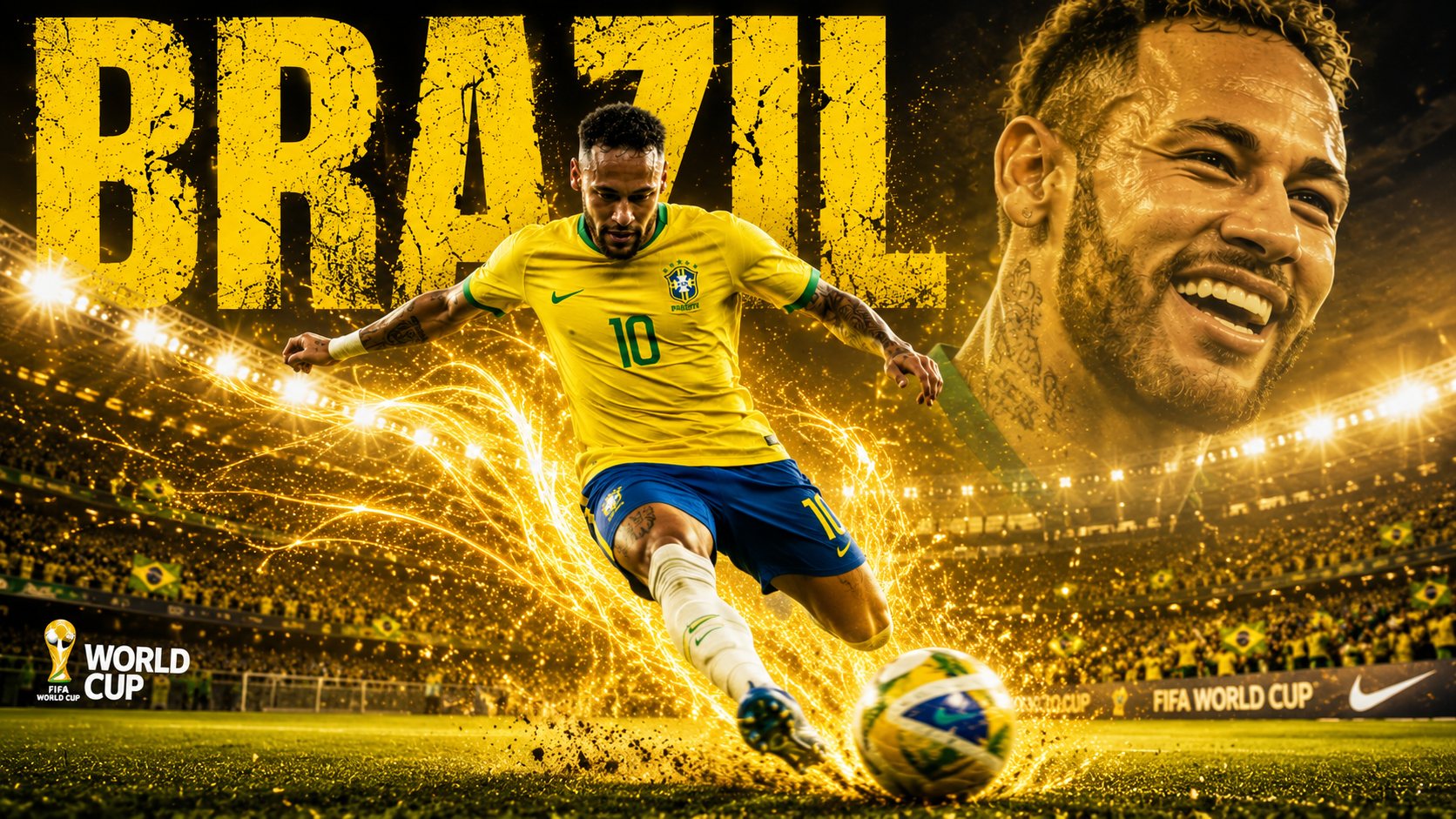
In this guide, we are going to break down an incredibly detailed, multi-layered visual concept: a Brazilian football player (wearing the iconic yellow No. 10 jersey) executing a powerful kick in a roaring World Cup stadium. We will analyze the specific physical, lighting, and camera instructions required to make this shot look authentic, and provide separate optimized templates for static images and cinematic video sequences.
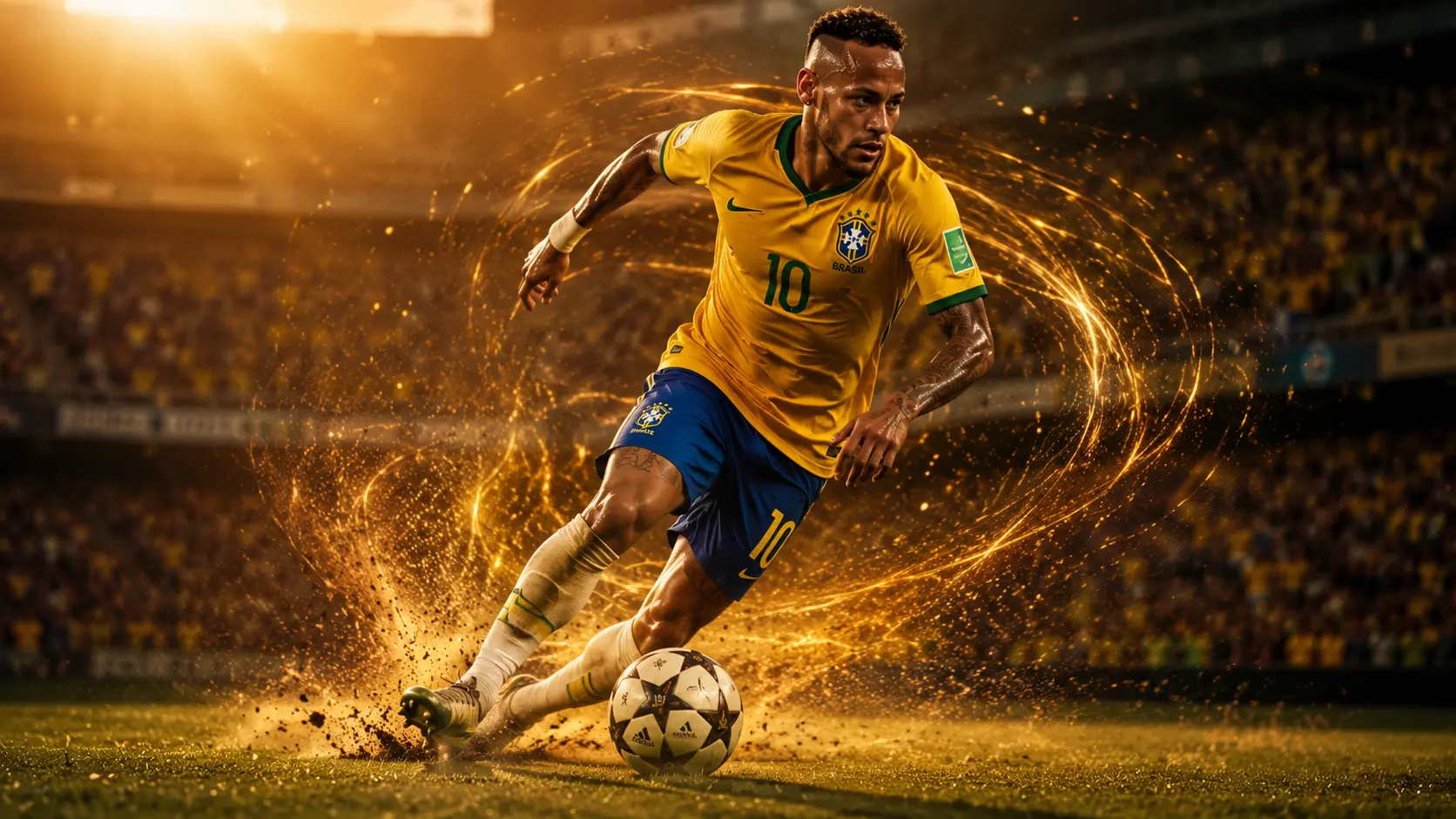
Anatomy of the Visual Concept
The core prompt we are dissecting is highly ambitious. It attempts to organize a complex, multi-layered composition within a single 9:16 vertical frame. In professional branding and design workflows, organizing elements into distinct layers is crucial for achieving visual balance. Let's examine how this concept structures its space:
- The Subject: A Brazilian football player wearing the exact national home kit colors (yellow base with green trim, blue shorts, white socks, and blue boots). He must have an excited, high-energy facial expression.
- The Composition Layers:
- Foreground: The player in sharp focus, dribbling and preparing to strike the ball.
- Midground: High-speed, rising streams of golden light particles to accentuate the trajectory and motion.
- Background: A brightly lit World Cup stadium with a cheering crowd, heavily blurred with a shallow depth of field to draw focus to the player.
- Overlay (Upper Third): A heavily blurred close-up of the player's smiling face, a waving Brazilian flag, and bold, distressed static text reading "BRAZIL".
- The Lighting Physics: A high-saturation warm gold palette illuminated by sharp, stage-style spotlights to mimic premium commercial sports advertisements.
The Realist's Warning: While this detailed layout is beautiful on paper, pasting this entire description into an AI image generator will almost certainly result in "prompt clutter". Single-shot models struggle to separate a sharp foreground player from a heavily blurred, transparent face in the same upper-frame overlay without bleeding the features together. Let's look at how we can adapt this concept realistically depending on whether we want a static image or a video clip.
How Different AI Engines Handle the Action
To implement this successfully, we must match our prompts to the strengths of specific model architectures. This level of adaptation is a key practice when building commercial assets.
| Model Class | Primary Strength | The Real-World Bottleneck |
|---|---|---|
| Image Generators (Midjourney v6.1 / Flux) | Sensational fabric textures (jersey weave), skin pores, and stadium lighting. Flux will render the word "BRAZIL" with high accuracy. | Struggles with the multi-layered overlay. It may try to physically merge the waving flag into the player's clothing or create a surreal "double-headed" character. |
| Video Generators (Runway Gen-3 / Kling) | Executes the camera movement ("low-angle slow push-in") and the physical mechanics of the kick realistically. | Extremely prone to "character drift" (the jersey numbers or colors may warp mid-video) and cannot maintain sharp, static graphic text overlays. |
The Practical Adaptation: Split Workflows
If you are designing this for a real campaign, the most effective workflow is to split the creative concept. Do not ask the AI to do everything at once. Instead, use these two distinct strategies:
1. The Video-First Prompt (Optimized for Runway Gen-3, Kling, or Sora)
For video generation, we strip out the static typography overlays and the transparent face. We focus purely on the physical performance, the camera physics, and the environmental atmosphere. You can add the distressed text "BRAZIL" and the static flag during post-production in professional editing suites, which allows for significantly more control over the final composition than relying on experimental AI generation layers.
A cinematic, live-action sports commercial sequence, 9:16 vertical screen. A highly realistic professional football player wearing a yellow jersey with green trim, blue shorts, and white socks is sprinting forward, dribbling a football inside a packed, brightly lit World Cup stadium. Captured from a low-angle perspective with a slow camera push-in. The player strikes the ball with explosive force, sending it flying toward the camera. Dense, fast-rising golden light particles surge behind him, creating a strong sense of motion. The stadium stands are filled with a cheering crowd, rendered with a shallow depth of field blur. Dynamic motion blur, intense visual impact, high-saturation warm gold color palette with deep contrast, hyper-realistic skin textures and grass blades, 4k resolution.
2. The High-Impact Image Prompt (Optimized for Midjourney v6.1 / Flux)
For a static poster or social media graphic, we capture the "peak freeze-frame." We structure the prompt to establish clear spatial boundaries so the generator understands that the background stadium must remain soft, while the player and the primary text "BRAZIL" are rendered as distinct, crisp layers.
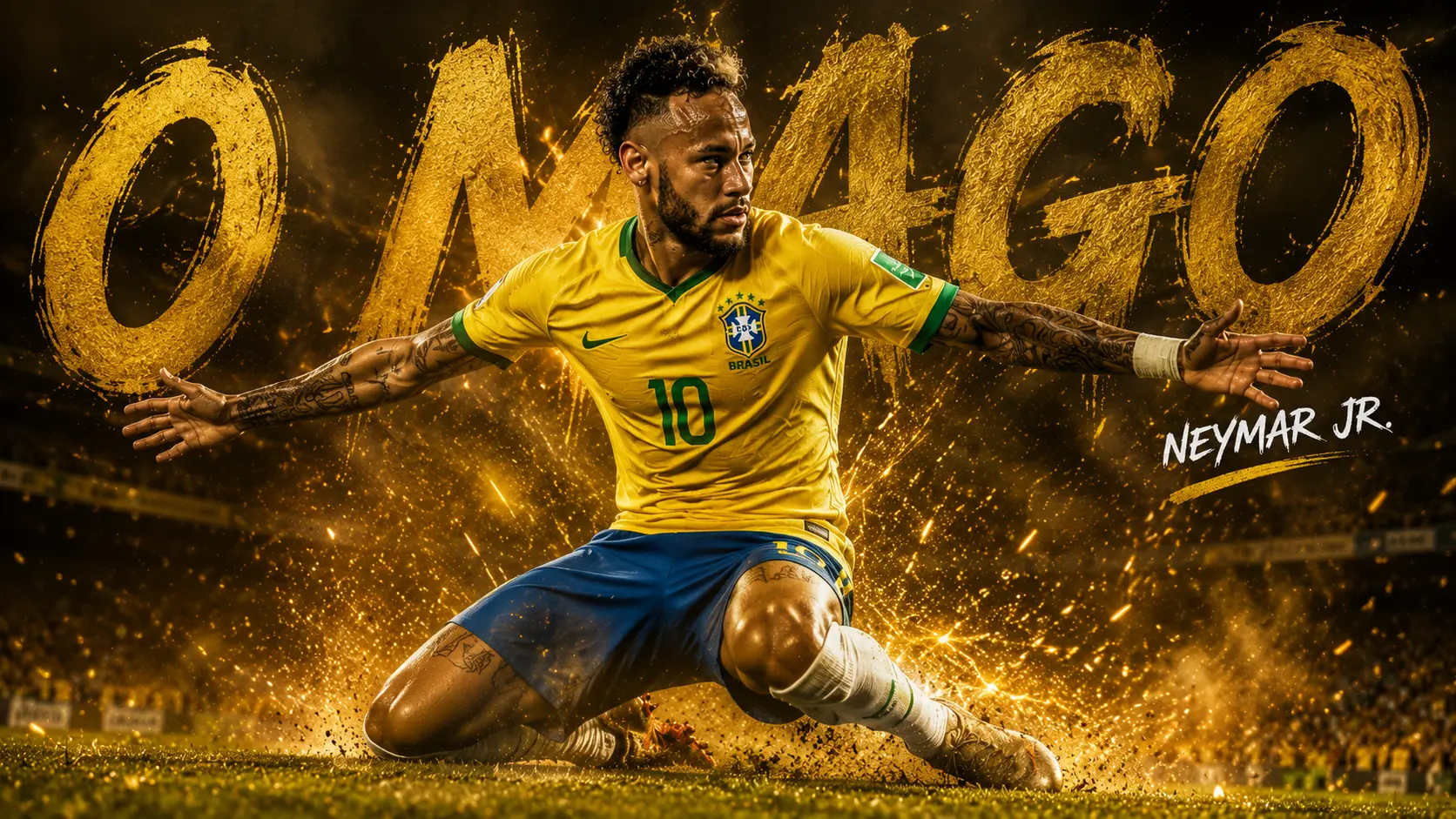
A hyper-realistic, high-impact sports poster, 9:16 aspect ratio. In the foreground, a professional football player wearing a yellow jersey with green trim and blue shorts is captured mid-air, kicking a football with explosive energy. The football has a highly detailed, granular leather texture. In the background, a massive World Cup stadium filled with cheering crowds is illuminated by sharp, dramatic stage spotlights, processed with deep shallow depth of field blur. Floating golden light particles drift around the player to amplify speed. In the upper third of the frame, the bold uppercase text "BRAZIL" is written in a distressed, street-style sans-serif font, cleanly separated from the action below. High-saturation color palette, warm gold tones, cinematic commercial aesthetic, 8k resolution --ar 9:16 --v 6.1 --style raw
Key Prompting Takeaways for Sports Design
Whether you are building a repository of sports concepts or designing a single custom campaign, your success depends on moving beyond generic modifiers. Great AI sports graphics are not created by simply adding words like "awesome" or "perfect". They are built by defining realistic camera optics, specific color coordination, and logical depth layers. By understanding the mechanical limitations of current video and image models, you can design prompts that work with the technology rather than fighting against it.